


We understand the hesitation — every exam site claims quality. So don't take the claim: take the free C-ADBTP-2601 demo from Prep4away and let the SAP Administrating SAP Business Technology Platform(C_ADBTP_2601) questions themselves convince you.
SAP C-ADBTP-2601 Exam Syllabus Topics:
| Section | Objectives |
|---|---|
| Billing, Entitlements, and Lifecycle Management | - Commercial model and usage control
|
| Monitoring and Operations | - System monitoring and troubleshooting
|
| SAP Business Technology Platform Fundamentals | - BTP global account concepts and structure
|
| Security and Identity Management | - Authentication and authorization
|
| Account and Subaccount Administration | - Subaccount lifecycle management
|
| Connectivity and Integration | - Connectivity setup in SAP BTP
|
SAP Administrating SAP Business Technology Platform(C_ADBTP_2601) FAQ: What You Need to Know
180 minutes for Approximately 80 questions — tighter than it looks once hard items start eating minutes. Train the pace now: assign each question a time budget, flag the stubborn ones, and run full timed sessions in the Prep4away engine so test day feels like practice, not pressure.
Yes:
Courses build the base; measurement finishes the job. Once training ends, the C-ADBTP-2601 practice questions from Prep4away show whether the knowledge actually holds under exam conditions.
6 domains make up the SAP Administrating SAP Business Technology Platform(C_ADBTP_2601) blueprint, led by Billing, Entitlements, and Lifecycle Management, Account and Subaccount Administration, Security and Identity Management. The weights show where the vendor concentrates its questions — that's where your hours should concentrate too. The complete outline above details every subtopic.
Delivery is automatic: successful payment emails the product to your mailbox within a minute — install on unlimited computers, and if 2 hours pass with nothing (check spam first), contact us. If you fail: sit the corresponding C-ADBTP-2601 exam within 60 days of purchase, then submit a scanned enrollment slip and official Score Report PDF within 2 days of the exam — full refund, processed within 7 days. Excluded: exams taken within 3 days of purchase, name mismatches between candidate and payer, and free or expired products. Alternatively, exchange for two equal-value exam products free and keep your updates.
The C-ADBTP-2601 exam is SAP's official certification exam for the SAP Certified Associate - Administrating SAP Business Technology Platform credential, positioned at the Associate level. It has never been considered easy — which is precisely why it impresses employers. It also relates to SAP Certified Associate - SAP Business Technology Platform, SAP Certified Technology Associate - SAP BTP Administration (related tracks).
Through the vendor's official registration channels:
The exam is available Online proctored exam or authorized test center delivery depending on region. — pick the delivery method that suits you at booking.
The enrollment fee is Varies by country (~USD 500 range) — not cheap — and the passing score is Approximately 64%. Since the fee applies in full to every attempt, each retake doubles down on the cost. The smarter sequence: drill the 10 practice questions from Prep4away first, book the exam second.
Yes — hesitating is normal, and the free demo exists for exactly that. Download it, get a feel for the SAP Administrating SAP Business Technology Platform(C_ADBTP_2601) questions, and decide with confidence. Purchases include 365 days of free updates, with new versions announced by email; after expiry, renew at 50% off.
Basic understanding of SAP Business Technology Platform administration concepts is recommended. Rules like these do change — confirm the current criteria on the official exam page before registering.
SAP Administrating SAP Business Technology Platform(C_ADBTP_2601) Sample Questions:
SIMULATION
Establish Shared Services
Task 1: Create a Shared Services Directory and Subaccounts
In your SAP BTP cockpit, create the directory Shared Services (Description: Shared Accounts) with your global account as the parent.
In the Shared Services directory, create the subaccount SH Dev (Description: Shared Services Development) with subdomain btpops####-sh-dev in the region Amazon Web Services (AWS) → Europe (Frankfurt) cf-eu10.
In the Shared Services directory, create the subaccount SH Ops (Description: Shared Services Operations) with subdomain btpops####-sh-ops in the region Amazon Web Services (AWS) → Europe (Frankfurt) cf-eu10.
Correct Answer:
See the Explanation below for complete solution.
Explanation:
Before You Start
Log in to the SAP BTP Cockpit.
Open the correct Global Account.
Make sure you are working in the correct global account before creating anything.
Why this matters:
The new directory and both subaccounts must be created inside the correct global account hierarchy.
Part A - Create the Shared Services Directory
Step 1 - Open Directories
What to do
In the SAP BTP Cockpit, open your Global Account.
In the left navigation menu, click Directories.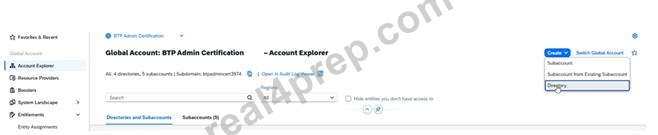
Explanation:
This is where you create and manage directory structures under the global account.
What to verify
You should now see the list of existing directories.
Step 2 - Create the Directory Shared Services
What to do
Click Create or Create Directory.
Enter the following values:
Name: Shared Services
Description: Shared Accounts
Parent: your Global Account
Click Create.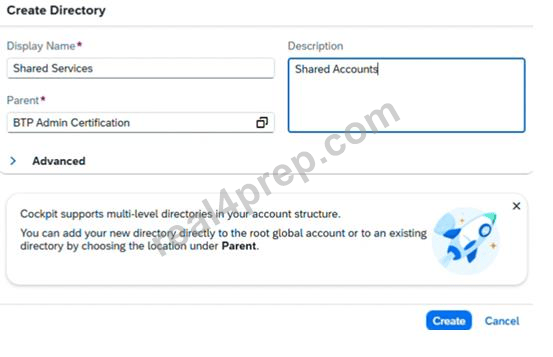
Explanation:
This creates a new top-level directory directly under the global account.
It will be used to hold the shared-services subaccounts.
What to verify
You should now see:
Shared Services
under the global account.
Part B - Create the SH Dev Subaccount
Step 3 - Open the Shared Services Directory
What to do
In the directory list, select Shared Services.
Explanation:
Both required subaccounts must be created inside this directory.
What to verify
You should now be inside the Shared Services directory.
Step 4 - Open Subaccounts
What to do
Inside Shared Services, open Subaccounts.
Click Create → Subaccount.
Explanation:
This opens the subaccount creation screen.
Step 5 - Create SH Dev
What to do
Enter the following:
Display Name / Name: SH Dev
Description: Shared Services Development
Subdomain: btpops####-sh-dev
Set the region as:
Cloud Provider: Amazon Web Services (AWS)
Region: Europe (Frankfurt)
Technical Region / Environment: cf-eu10
Then click Create.
Explanation:
This creates the shared services development subaccount in the required AWS Frankfurt region.
What to verify
After creation, you should see:
SH Dev
inside the Shared Services directory.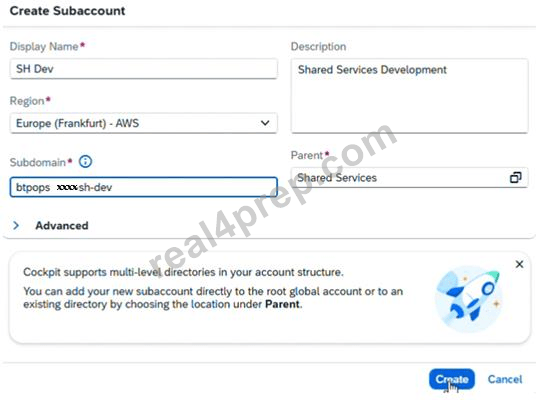
Part C - Create the SH Ops Subaccount
Step 6 - Start a New Subaccount
What to do
Still inside Shared Services, click Create → Subaccount again.
Explanation:
This opens the form for the second required subaccount.
Step 7 - Create SH Ops
What to do
Enter the following:
Display Name / Name: SH Ops
Description: Shared Services Operations
Subdomain: btpops####-sh-ops
Set the region as:
Cloud Provider: Amazon Web Services (AWS)
Region: Europe (Frankfurt)
Technical Region / Environment: cf-eu10
Then click Create.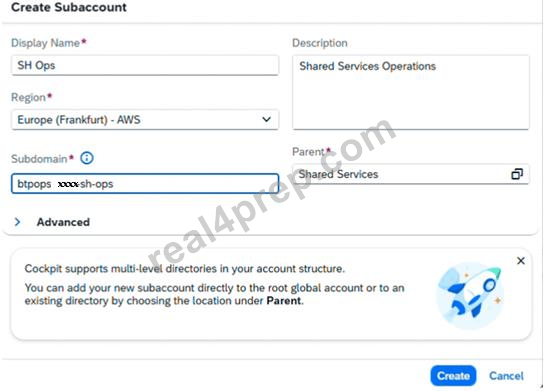
Explanation:
This creates the shared services operations subaccount in the same required region.
What to verify
After creation, you should see:
SH Ops
inside the Shared Services directory.
Final Expected Result for Task 1
You should now have:
Directory
Shared Services
Description: Shared Accounts
Parent: Global Account
Subaccounts inside Shared Services
SH Dev
Description: Shared Services Development
Subdomain: btpops####-sh-dev
Region: AWS → Europe (Frankfurt) cf-eu10
SH Ops
Description: Shared Services Operations
Subdomain: btpops####-sh-ops
Region: AWS → Europe (Frankfurt) cf-eu10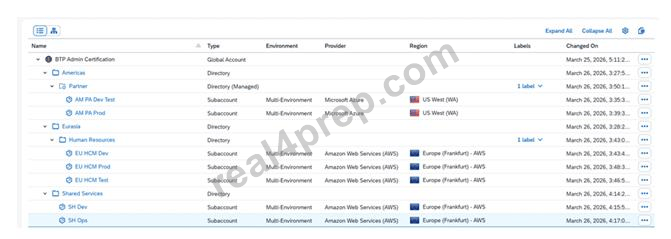
Common Mistakes to Avoid
1. Creating the directory in the wrong place
Shared Services must be created with:
parent = Global Account
2. Creating the subaccounts outside the directory
Both subaccounts must be created inside:
Shared Services
3. Wrong subdomain values
Use exactly:
btpops####-sh-dev
btpops####-sh-ops
Only replace #### with your global account number.
4. Wrong region
Both subaccounts must use:
Amazon Web Services (AWS)
Europe (Frankfurt)
cf-eu10
5. Mixing up SH Dev and SH Ops
Be careful:
SH Dev = Shared Services Development
SH Ops = Shared Services Operations


