


Throughout 2026, Prep4away keeps refining its C_ABAPD_2309 question bank with verified answers and daily update checks, so the SAP Certified Associate - Back-End Developer - ABAP Cloud material on your screen is always the current edition — no printing, no shipping, no waiting.
SAP C_ABAPD_2309 Exam Syllabus Topics:
| Section | Weight | Objectives |
|---|---|---|
| SAP Clean Core Extensibility and ABAP Cloud | 11%-20% | - Cloud Development Principles
|
| ABAP Core Data Services and Data Modeling | 21%-30% | - CDS Views and Data Modeling
|
| Core ABAP Programming | 31%-40% | - ABAP Language Fundamentals
|
| Object-Oriented Design | 11%-20% | - OO ABAP Concepts
|
| ABAP SQL and Code Pushdown | <10% | - Database Processing
|
| ABAP RESTful Application Programming Model | 11%-20% | - RAP Development
|
SAP Certified Associate - Back-End Developer - ABAP Cloud Essentials: What Candidates Ask
- ABAP SQL and Code Pushdown (<10%)
- ABAP RESTful Application Programming Model (11%-20%)
- Core ABAP Programming (31%-40%)
SAP Certified Associate - Back-End Developer - ABAP Cloud Sample Questions:
<some coding>
IF <condition>.
RAISE EXCEPTION TYPE zcx1
EXPORTING
param1 = value1
param2 = value2
previous = value3.
ENDIF.
What are valid statements? Note: There are 2 correct answers to this question.
- A. "zcxl" is a dictionary structure, and "paraml" and "param2" are this structure.
- B. "previous" expects the reference to a previous exception
- C. "paraml11 and "param2" are predefined names.
- D. The code creates an exception object and raises an exception.
Correct Answer: B,D 🗳️
Explanation: Only visible for Prep4away members. You can sign-up / login (it's free).
What are advantages of using a field symbol for internal table row access? Note: There are answers to this question.
- A. Using a field symbol is faster than using a work area.
- B. A MODIFY statement to write changed contents back to the table is not required.
- C. The field symbol can be reused for other programs.
- D. The row content is copied to the field symbol instead to a work area
Correct Answer: A,B 🗳️
Explanation: Only visible for Prep4away members. You can sign-up / login (it's free).
You have a superclass superl and a subclass subl of superl. Each class has an instance constructor and a static constructor. The first statement of your program creates an instance of subl. In which sequence will the constructors be executed?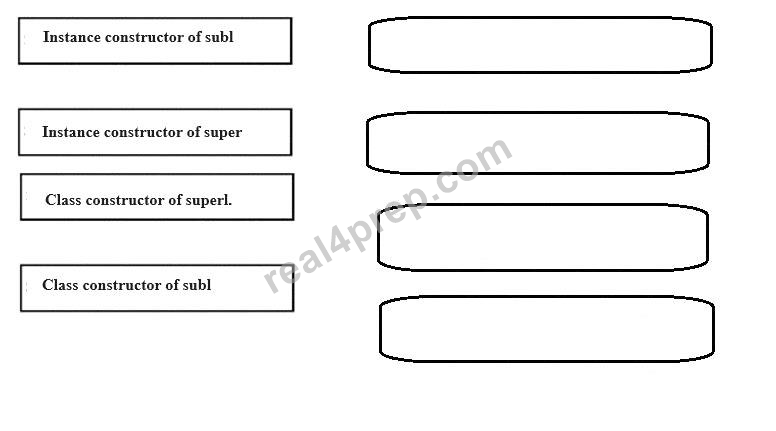
Correct Answer:

Explanation:
The sequence in which the constructors will be executed is as follows:
* Class constructor of superl. This is because the class constructor is a static method that is executed automatically before the class is accessed for the first time. The class constructor is used to initialize the static attributes and components of the class. The class constructor of the superclass is executed before the class constructor of the subclass, as the subclass inherits the static components of the superclass12
* Class constructor of subl. This is because the class constructor is a static method that is executed automatically before the class is accessed for the first time. The class constructor is used to initialize the static attributes and components of the class. The class constructor of the subclass is executed after the class constructor of the superclass, as the subclass inherits the static components of the superclass12
* Instance constructor of superl. This is because the instance constructor is an instance method that is executed automatically when an instance of the class is created using the statement CREATE OBJECT.
The instance constructor is used to initialize the instance attributes and components of the class. The instance constructor of the superclass is executed before the instance constructor of the subclass, as the subclass inherits the instance components of the superclass. The instance constructor of the subclass must call the instance constructor of the superclass explicitly using super->constructor, unless the superclass is the root node object12
* Instance constructor of subl. This is because the instance constructor is an instance method that is executed automatically when an instance of the class is created using the statement CREATE OBJECT.
The instance constructor is used to initialize the instance attributes and components of the class. The instance constructor of the subclass is executed after the instance constructor of the superclass, as the subclass inherits the instance components of the superclass. The instance constructor of the subclass must call the instance constructor of the superclass explicitly using super->constructor, unless the superclass is the root node object12 References: Constructors of Classes - ABAP Keyword Documentation, METHODS - constructor - ABAP Keyword Documentation
After you created a database table in the RESTful Application Programming model, what do you create next?
- A. A data model view
- B. A projection view
- C. A metadata extension
- D. A service definition
Correct Answer: B 🗳️
Explanation: Only visible for Prep4away members. You can sign-up / login (it's free).
Given the Code:
INTERFACE if1.
METHODS m1.
ENDINTERFACE.
CLASS cl1 DEFINITION.
...
INTERFACES if1.
ENDCLASS.
CLASS cl2 DEFINITION.
...
DATA mo_if1 TYPE REF TO if1.
ENDCLASS.
What are valid statements? (Note: There are 3 correct answers to this question.)
- A. Class cl2 uses the interface.
- B. Class cl1 uses the interface.
- C. Class cl1 implements the interface.
- D. In class cl1, the interface method is named if1~m1.
- E. In class cl2, the interface method is named if1~m1.
Correct Answer: B,C,E 🗳️
Explanation: Only visible for Prep4away members. You can sign-up / login (it's free).
Viewing page 1 out of 17 pages.
Viewing questions 1-5 out of 85 questions.


