


Every candidate who has passed the QSDA2019 exam started where you are now — uncertain, busy, and wondering whether the effort is worth it. Prep4away answers the uncertainty part with a free demo of the Qlik Sense Data Architect Certification practice materials and backs the effort part with 52+ Q&As and expert-verified answers.
Qlik QSDA2019 Exam Syllabus Topics:
| Section | Weight | Objectives |
|---|---|---|
| Design Data Models | 30% | - Implement calendars, flags, and set analysis support structures - Determine appropriate data model architecture - Manage complex modeling scenarios - Design scalable and reusable data models |
| Validate Data | 20% | - Debug and troubleshoot script errors - Validate data models against source systems - Resolve synthetic keys and circular references - Resolve data quality and formatting issues |
| Build Data Models | 40% | - Implement Section Access security - Manage data connections and data sources - Use data transformation techniques in Data Load Editor and Data Manager - Create and transform data models using load scripts - Perform joins, keeps, resident loads, and incremental loads |
| Identify Model Requirements | 10% | - Identify data load and refresh requirements - Determine security requirements - Identify Qlik Sense features to meet business requirements |
QSDA2019 Exam Basics: What Every Candidate Asks
The QSDA2019 exam is the required test for earning the Qlik Sense Data Architect Certification certification from Qlik. It assesses your command of the official exam objectives through scenario-based and knowledge questions, and the resulting credential is widely recognized by employers. Its reputation for difficulty is real but manageable — candidates who practice consistently with quality materials routinely walk in well prepared.
The official outline for the QSDA2019 exam highlights these domains:
- Design Data Models (30%)
- Build Data Models (40%)
- Identify Model Requirements (10%)
Seeing the topics laid out this way often shrinks the exam's intimidation factor — each domain is a finite, learnable block, and the Qlik Sense Data Architect Certification practice questions at Prep4away follow the same structure.
No mandatory prerequisite. Practical experience with Qlik Sense data modeling, scripting, and data architecture is strongly recommended.
The QSDA2019 exam is demanding, but its difficulty is specific, not mysterious: unfamiliar question formats, time pressure, and a few heavily weighted domains. All three respond to the same remedy — repeated, timed exposure to exam-style questions. That is what the Qlik Sense Data Architect Certification practice materials at Prep4away provide, and the free demo lets you measure the real difficulty yourself before committing, which is usually the moment the fear starts shrinking.
The QSDA2019 exam consists of 50 questions with a time allowance of 120 minutes minutes. Practicing full sets under a similar time cap is the most direct way to make sure pacing never costs you points on exam day.
Because seeing beats guessing. The free demo of the QSDA2019 exam materials at Prep4away contains genuine samples from the full Qlik Sense Data Architect Certification question set — same format, same expert-verified answers — and downloading it costs nothing. If you are unsure whether the materials match your level or your study style, the demo answers that question with evidence rather than marketing, and every demo on the site is free of charge.
The passing score is 70% and the exam fee is USD 250. Knowing both numbers early helps you plan: aim to be consistently above the passing mark in timed practice sessions before you spend the fee on a booking.
Qlik Sense Data Architect Certification Sample Questions:
Multiple department fields in a dataset require a description.
A data architect needs to add the department descriptions or a default value when the department does NOT have a description.
Which strategy should the data architect use to meet these requirements?
- A. ApplyMap with two parameters after the Mapping load
- B. Enter "Missing description" in the blank rows for Description.xlsx, then use Mapping Load
- C. Left Join between tables and Description.xlsx in every Department table
- D. ApplyMap with three parameters after the Mapping load
Correct Answer: A 🗳️
Refer to the exhibits.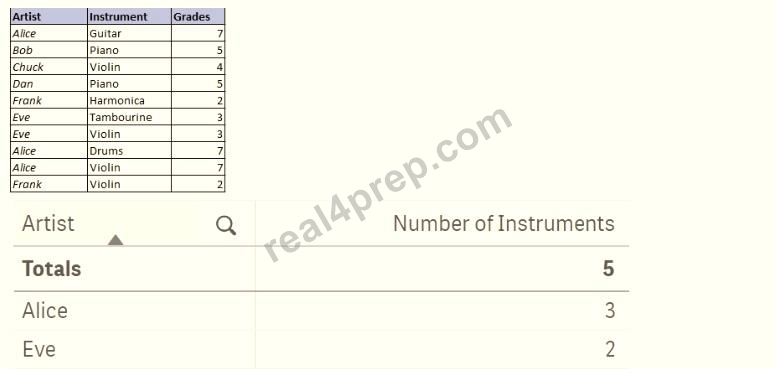
A music teacher needs to know which artists are eligible to enter this year's competition.
The teacher needs to find only the artists who have a music grade rank above two and play more than one instrument.
Which expression is needed for the Number of Instruments measure in the table?
- A. Count({$<Instrument={">=2"}, Artist={"=Grade>2"}>}Instrument)
- B. Count({$<Artist={"=Count(Instrument)>=2"}, Artist={"=Grade>2"}>}Instrument)
- C. Count ({S<Artist={"=Count(Instrument)>=2M}, Grades={">2"}>}Instrument)
- D. Count({S<Count(Instrument)={">=2"}, Grades={">2"}>}Instrument)
Correct Answer: B 🗳️
A data architect wants to combine data on present and historic sales performance. The historic data is stored in a de-normalized archive, and the present data is maintained in a database. The output must be contained in a single table.
Which script should the data architect use?
A)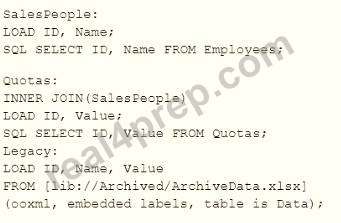
B)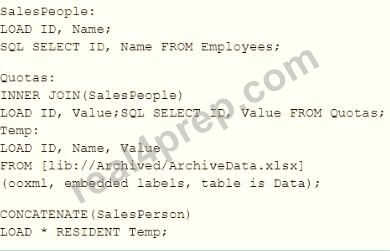
C)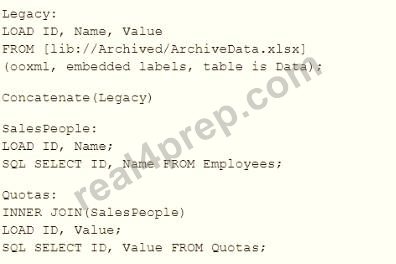
D)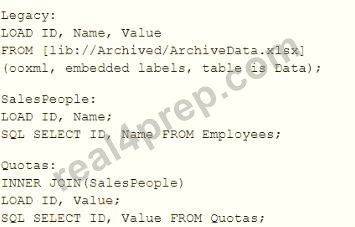
- A. Option A
- B. Option C
- C. Option D
- D. Option B
Correct Answer: A 🗳️
Refer to the exhibit.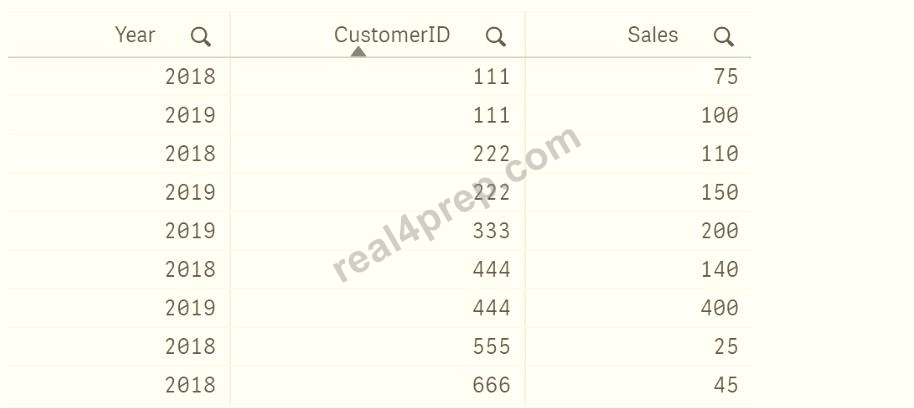
A data architect loads sales data and creates a table which shows only customers who made purchases in 2018 and 2019. The data architect applies the following set analysis expression on the sales measure. Count<{<Year={'2 018'}, CustomerID=P({<Year={'2019*}>})>} Customer ID) Which option shows the resulting table after the expression is applied?
A)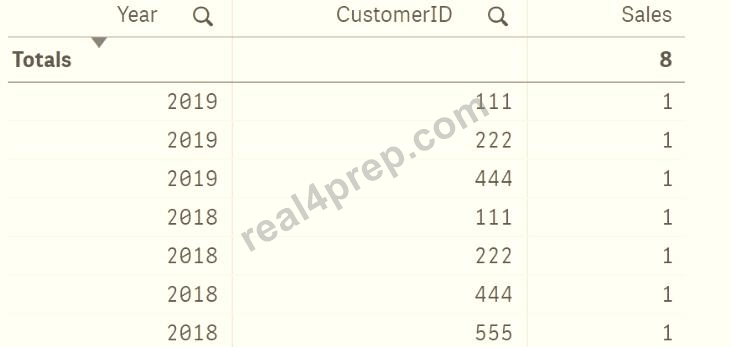
B)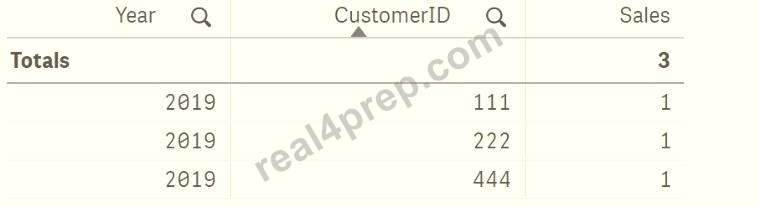
C)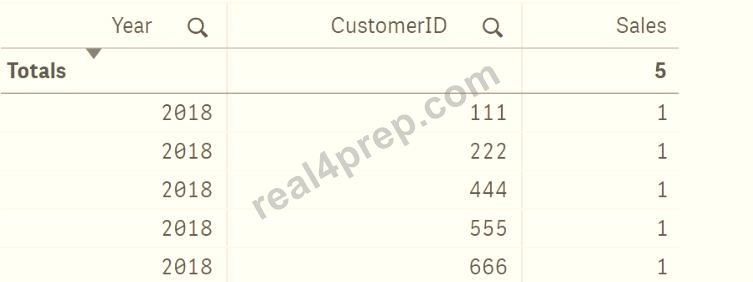
D)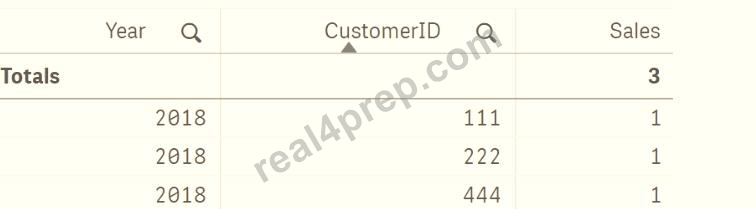
- A. Option A
- B. Option C
- C. Option D
- D. Option B
Correct Answer: C 🗳️
A company generates 1 GB of ticketing data daily. The data is stored in multiple tables Business users need to see trends of tickets processed for the past two years. Users very rarely access the transaction-level data for a specific date. Only the past two years of data must be loaded which is 720 GB of data Which method should a data architect use to meet these requirements?
- A. Load only aggregated data for two years and use ODAG for transaction data
- B. Load only two years of data in an aggregated app and create a separate transaction app for occasional use
- C. Load only aggregated data for two years and use Direct Discovery for transaction data
- D. Load only two years of data and use best practices in scripting and visualization to calculate and display aggregated data
Correct Answer: A 🗳️
Viewing page 1 out of 11 pages.
Viewing questions 1-5 out of 52 questions.


