


Check Real CompTIA CS0-003 Exam Question for Free (2026)
Get Ready to Boost your Prepare for your CS0-003 Exam with 490 Questions
CompTIA Cybersecurity Analyst (CySA+) Certification is recognized by employers worldwide and is in high demand. CompTIA Cybersecurity Analyst (CySA+) Certification Exam certification demonstrates that the candidate has the skills and knowledge to protect against cybersecurity threats and incidents. CompTIA Cybersecurity Analyst (CySA+) Certification Exam certification is ideal for professionals who are looking to advance their careers in cybersecurity and want to demonstrate their expertise in this field.
CompTIA CySA+ CS0-003 certification exam is an excellent way for cybersecurity professionals to validate their skills and knowledge. It is a globally recognized certification that demonstrates the candidate's ability to identify and mitigate cybersecurity threats. Candidates who pass the exam are well-prepared to pursue a career in cybersecurity or advance their existing skills to the next level.
NEW QUESTION # 48
The help desk is having difficulty keeping up with all onboarding and offboarding requests.
Managers often submit, requests for new users at the last minute. causing the help desk to scramble to create accounts across many different Interconnected systems. Which of the following solutions would work BEST to assist the help desk with the onboarding and offboarding process while protecting the company's assets?
- A. SSO
- B. MFA
- C. CASB
- D. RBAC
Answer: A
Explanation:
SSO single sign on allows you access to multiple resources without the need to reauthenticate.
Role-based is a type of access control. Based on your job-role you have access to a specific object.
NEW QUESTION # 49
An analyst is reviewing a vulnerability report and must make recommendations to the executive team. The analyst finds that most systems can be upgraded with a reboot resulting in a single downtime window. However, two of the critical systems cannot be upgraded due to a vendor appliance that the company does not have access to. Which of the following inhibitors to remediation do these systems and associated vulnerabilities best represent?
- A. Unsupported operating systems
- B. Legacy systems
- C. Proprietary systems
- D. Lack of maintenance windows
Answer: C
Explanation:
Proprietary systems are systems that are owned by their developer or vendor, and the company does not have access to the source code or other necessary information to upgrade or patch the system. This can make it difficult to remediate vulnerabilities in proprietary systems, as the company may need to rely on the vendor to provide a patch or update.
In this case, the two critical systems cannot be upgraded due to a vendor appliance that the company does not have access to. This suggests that the systems are proprietary, and the company is unable to remediate the vulnerabilities without the vendor's assistance.
NEW QUESTION # 50
A security analyst reviews the following Arachni scan results for a web application that stores PII data: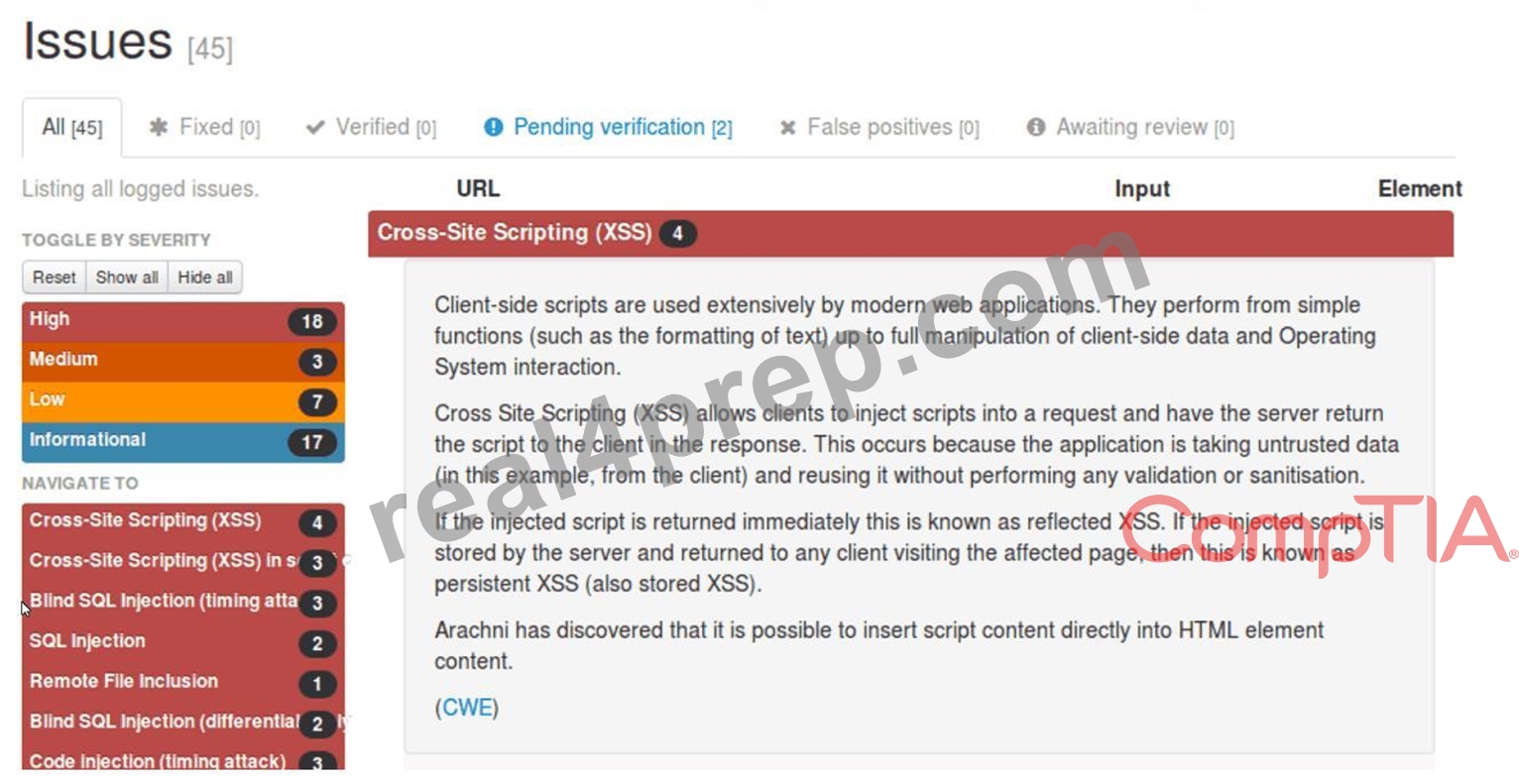
Which of the following should be remediated first?
- A. RFI
- B. SQL injection
- C. Code injection
- D. XSS
Answer: B
Explanation:
SQL injection should be remediated first, as it is a high-severity vulnerability that can allow an attacker to execute arbitrary SQL commands on the database server and access, modify, or delete sensitive data, including PII. According to the Arachni scan results, there are two instances of SQL injection and three instances of blind SQL injection (two timing attacks and one differential analysis) in the web application.
These vulnerabilities indicate that the web application does not properly validate or sanitize the user input before passing it to the database server, and thus exposes the database to malicious queries12. SQL injection can have serious consequences for the confidentiality, integrity, and availability of the data and the system, and can also lead to further attacks, such as privilege escalation, data exfiltration, or remote code execution34.
Therefore, SQL injection should be the highest priority for remediation, and the web application should implement input validation, parameterized queries, and least privilege principle to prevent SQL injection attacks5. References: Web application testing with Arachni | Infosec, How do I create a generated scan report for PDF in Arachni Web ..., Command line user interface Arachni/arachni Wiki GitHub, SQL Injection - OWASP, Blind SQL Injection - OWASP, SQL Injection Attack: What is it, and how to prevent it., SQL Injection Cheat Sheet & Tutorial | Veracode
NEW QUESTION # 51
A security analyst is reviewing a firewall usage report that contains traffic generated over the last
30 minutes in order to locate unusual traffic patterns: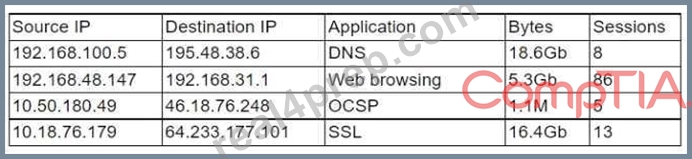
Which of the following source IP addresses does the analyst need to investigate further?
- A. 192.168.100.5
- B. 10.18.76.179
- C. 192.168.48.147
- D. 10.50.180.49
Answer: C
NEW QUESTION # 52
A software developer has been deploying web applications with common security risks to include insufficient logging capabilities. Which of the following actions would be most effective to reduce risks associated with the application development?
- A. Deploy compensating controls into the environment.
- B. Conduct regular code reviews using OWASP best practices.
- C. Perform static analyses using an integrated development environment.
- D. Implement server-side logging and automatic updates.
Answer: B
Explanation:
Conducting regular code reviews using OWASP best practices is the most effective action to reduce risks associated with the application development. Code reviews are a systematic examination of the source code of an application to detect and fix errors, vulnerabilities, and weaknesses that may compromise the security, functionality, or performance of the application. Code reviews can help to improve the quality and security of the code, as well as to identify and remediate common security risks, such as insufficient logging capabilities. OWASP (Open Web Application Security Project) is a global nonprofit organization that provides free and open resources, tools, standards, and best practices for web application security. OWASP best practices for logging include following a common logging format and approach, logging relevant security events and data, protecting log data from unauthorized access or modification, and using log analysis and monitoring tools to detect and respond to security incidents. By following OWASP best practices for logging, developers can ensure that their web applications have sufficient and effective logging capabilities that can help to prevent, detect, and mitigate security threats.
NEW QUESTION # 53
An organization has a critical financial application hosted online that does not allow event logging to send to the corporate SIEM. Which of the following is the best option for the security analyst to configure to improve the efficiency of security operations?
- A. Download and manually import the logs outside of business hours.
- B. Subscribe to a threat feed related to the vendor's application.
- C. Configure a new SIEM specific to the management of the hosted environment.
- D. Use a vendor-provided API to automate pulling the logs in real time.
Answer: D
NEW QUESTION # 54
Which of the following is MOST important when developing a threat hunting program?
- A. Understanding how to build correlation rules within a SIEM
- B. Understanding security software technologies
- C. Understanding assets and categories of assets
- D. Understanding penetration testing techniques
Answer: B
Explanation:
When creating a threat hunting program it is important to start by developing standardized processes to guide threat hunting efforts. Security teams should outline when and how hunting takes place (whether at scheduled intervals, in response to specific triggering actions, or continuously with the help of automated tools), what techniques are to be used, and which people and TOOLS will be responsible for performing specific threat hunting tasks.
NEW QUESTION # 55
During a security incident at a healthcare facility, an unauthorized user downloads multiple patients' PHI records. Which of the following is the best reason for the healthcare facility to communicate with the affected patients regarding the incident?
- A. To meet regulatory requirements
- B. To get support from law enforcement
- C. To appease the stakeholders
- D. To avoid legal liability
Answer: A
Explanation:
Healthcare organizations are subject to regulatory requirements regarding the protection and disclosure of Protected Health Information (PHI). When a breach involving PHI occurs, regulations such as HIPAA require affected individuals to be notified so they can take appropriate actions to protect themselves and remain informed about the exposure of their personal information.
NEW QUESTION # 56
An organization recently changed its BC and DR plans. Which of the following would best allow for the incident response team to test the changes without any impact to the business?
- A. Simulate an incident by shutting down power to the primary data center.
- B. Compare the current plan to lessons learned from previous incidents.
- C. Migrate active workloads from the primary data center to the secondary location.
- D. Perform a tabletop drill based on previously identified incident scenarios.
Answer: D
Explanation:
Performing a tabletop drill based on previously identified incident scenarios is the best way to test the changes to the BC and DR plans without any impact to the business, as it is a low-cost and low-risk method of exercising the plans and identifying any gaps or issues. A tabletop drill is a type of BC/DR exercise that involves gathering key personnel from different departments and roles and discussing how they would respond to a hypothetical incident scenario. A tabletop drill does not involve any actual simulation or disruption of the systems or processes, but rather relies on verbal communication and documentation review.
A tabletop drill can help to ensure that everyone is familiar with the BC/DR plans, that the plans reflect the current state of the organization, and that the plans are consistent and coordinated across different functions.
The other options are not as suitable as performing a tabletop drill, as they involve more cost, risk, or impact to the business. Simulating an incident by shutting down power to the primary data center is a type of BC/DR exercise that involves creating an actual disruption or outage of a critical system or process, and observing how the organization responds and recovers. This type of exercise can provide a realistic assessment of the BC
/DR capabilities, but it can also cause significant impact to the business operations, customers, and reputation.
Migrating active workloads from the primary data center to the secondary location is a type of BC/DR exercise that involves switching over from one system or site to another, and verifying that the backup system or site can support the normal operations. This type of exercise can help to validate the functionality and performance of the backup system or site, but it can also incur high costs, complexity, and potential errors or failures. Comparing the current plan to lessons learned from previous incidents is a type of BC/DR activity that involves reviewing past experiences and outcomes, and identifying best practices or improvement opportunities. This activity can help to update and refine the BC/DR plans, but it does not test or validate them in a simulated or actual scenario
NEW QUESTION # 57
A company receives a penetration test report summary from a third party. The report summary indicates a proxy has some patches that need to be applied. The proxy is sitting in a rack and is not being used, as the company has replaced it with a new one. The CVE score of the vulnerability on the proxy is a 9.8. Which of the following best practices should the company follow with this proxy?
- A. Leave the proxy as is.
- B. Patch the proxy.
- C. Migrate the proxy to the cloud.
- D. Decomission the proxy.
Answer: D
Explanation:
The best practice that the company should follow with this proxy is to decommission the proxy.
Decommissioning the proxy involves removing or disposing of the proxy from the rack and the network, as well as deleting or wiping any data or configuration on the proxy. Decommissioning the proxy can help eliminate the vulnerability on the proxy, as well as reduce the attack surface, complexity, or cost of maintaining the network. Decommissioning the proxy can also free up space or resources for other devices or systems that are in use or needed by the company.
NEW QUESTION # 58
The security operations team is required to consolidate several threat intelligence feeds due to redundant tools and portals. Which of the following will best achieve the goal and maximize results?
- A. Single sign-on
- B. Deduplication
- C. Single pane of glass
- D. Data enrichment
Answer: B
Explanation:
Deduplication is a process that involves removing any duplicate or redundant data or information from a data set or source. Deduplication can help consolidate several threat intelligence feeds by eliminating any overlapping or repeated indicators of compromise (IoCs), alerts, reports, or recommendations. Deduplication can also help reduce the volume and complexity of threat intelligence data, as well as improve its quality, accuracy, or relevance.
NEW QUESTION # 59
Which of the following is a KPI that is used to monitor or report on the effectiveness of an incident response reporting and communication program?
- A. Remediated incidents
- B. Incident volume
- C. Average time to patch
- D. Mean time to detect
Answer: D
Explanation:
Mean Time to Detect (MTTD) is the most appropriate Key Performance Indicator (KPI) to monitor the effectiveness of an incident response reporting and communication program among the choices provided.
* Why B is correct: The primary goal of an " incident reporting " program (whether automated by tools or reported by users/staff) is to alert the security team to an issue as quickly as possible. MTTD measures the average time it takes for an organization to identify (detect and report) an incident after it has occurred. A lower MTTD directly indicates that the reporting mechanisms and communication channels from the source to the analysts are operating effectively.
* Why A is incorrect: Incident volume measures the quantity of incidents, which reflects the threat landscape or workload rather than the effectiveness of the response program itself. While an increase in user-reported volume can indicate better awareness, MTTD is the standard performance metric for the process.
* Why C is incorrect: Average time to patch is a KPI for Vulnerability Management, not Incident Response reporting.
* Why D is incorrect: Remediated incidents refers to the volume of resolved issues (Response/Recovery phase) and does not specifically measure the speed or quality of the reporting and communication (detection) phase.
In Domain 4 (Reporting and Communication) and Domain 1 (Security Operations), CompTIA emphasizes the use of time-based metrics to evaluate process maturity.
* MTTD (Mean Time to Detect): Measures " dwell time " and the efficiency of the Detection & Reporting phase.
* MTTR (Mean Time to Respond): Measures the efficiency of the Response & Recovery phase.
NEW QUESTION # 60
Which of the following responsibilities does the legal team have during an incident management event?
(Select two).
- A. Advise the Incident response team on matters related to regulatory reporting.
- B. Coordinate additional or temporary staffing for recovery efforts.
- C. Ensure all system security devices and procedures are in place.
- D. Review and approve new contracts acquired as a result of an event.
- E. Verify that all security personnel have the appropriate clearances.
- F. Conduct computer and network damage assessments for insurance.
Answer: A,D
Explanation:
During an incident, the legal team plays a crucial role in handling regulatory compliance and reviewing legal implications, such as contractual obligations and reporting requirements. Advising on regulatory reporting (Option C) ensures the organization meets legal mandates, while reviewing contracts (Option B) can address new or emergency services needed during the incident. According to CompTIA CySA+ and Security+ guidelines, these legal responsibilities are vital for compliance and risk management. Options related to staffing, damage assessments, and clearances typically fall under operational or HR responsibilities rather than legal purview.
NEW QUESTION # 61
Which of the following is a reason why proper handling and reporting of existing evidence are important for the investigation and reporting phases of an incident response?
- A. To prevent the possible loss of a data source for further root cause analysis
- B. TO ensure the report is legally acceptable in case it needs to be presented in court
- C. To present a lessons-learned analysis for the incident response team
- D. To ensure the evidence can be used in a postmortem analysis
Answer: B
Explanation:
The correct answer is A. To ensure the report is legally acceptable in case it needs to be presented in court.
Proper handling and reporting of existing evidence are important for the investigation and reporting phases of an incident response because they ensure the integrity, authenticity, and admissibility of the evidence in case it needs to be presented in court. Evidence that is mishandled, tampered with, or poorly documented may not be accepted by the court or may be challenged by the opposing party. Therefore, incident responders should follow the best practices and standards for evidence collection, preservation, analysis, and reporting1.
The other options are not reasons why proper handling and reporting of existing evidence are important for the investigation and reporting phases of an incident response. They are rather outcomes or benefits of conducting a thorough and effective incident response process. A lessons-learned analysis (B) is a way to identify the strengths and weaknesses of the incident response team and improve their performance for future incidents. A postmortem analysis is a way to determine the root cause, impact, and timeline of the incident and provide recommendations for remediation and prevention. A root cause analysis (D) is a way to identify the underlying factors that led to the incident and address them accordingly.
NEW QUESTION # 62
A red-team exercise identifies the following string that was entered in a username field on a web application and caused data exposure:
' or 1=1; select * from users; --
Which of the following is the best strategy to remediate this issue?
- A. Secure coding best practices
- B. Patching and configuration management
- C. Attack surface management
- D. Compensating controls
Answer: A
Explanation:
The input string demonstrates a SQL injection attack, where malicious input is used to manipulate database queries and expose sensitive data. The most effective remediation is implementing secure coding practices such as input validation, parameterized queries, and proper sanitization of user inputs to prevent injection vulnerabilities in the application code.
NEW QUESTION # 63
The security team reviews a web server for XSS and runs the following Nmap scan: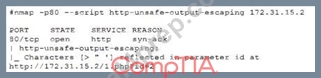
Which of the following most accurately describes the result of the scan?
- A. The vulnerable parameter and characters > and " with a reflected XSS attempt
- B. An output of characters > and " as the parameters used m the attempt
- C. The vulnerable parameter ID http://172.31.15.2/1.php?id-2 and unfiltered characters returned
- D. The vulnerable parameter and unfiltered or encoded characters passed > and " as unsafe
Answer: A
Explanation:
A cross-site scripting (XSS) attack is a type of web application attack that injects malicious code into a web page that is then executed by the browser of a victim user. A reflected XSS attack is a type of XSS attack where the malicious code is embedded in a URL or a form parameter that is sent to the web server and then reflected back to the user's browser. In this case, the Nmap scan shows that the web server is vulnerable to a reflected XSS attack, as it returns the characters > and " without any filtering or encoding. The vulnerable parameter is id in the URL
http://172.31.15.2/1.php?id=2.
NEW QUESTION # 64
Which of the following describes a contract that is used to define the various levels of maintenance to be provided by an external business vendor in a secure environment?
- A. NDA
- B. SLA
- C. MOU
- D. BIA
Answer: B
Explanation:
SLA stands for Service Level Agreement, which is a contract that defines the various levels of maintenance to be provided by an external business vendor in a secure environment. An SLA specifies the expectations, responsibilities, and obligations of both parties, such as the scope, quality, availability, and performance of the service, as well as the metrics and methods for measuring and reporting the service level. An SLA also outlines the penalties or remedies for any breach or failure of the service level. An SLA can help ensure that the external business vendor delivers the service in a timely, consistent, and secure manner, and that the customer receives the service that meets their needs and requirements. Official Reference:
https://partners.comptia.org/docs/default-source/resources/comptia-cysa-cs0-002-exam-objectives
https://www.comptia.org/certifications/cybersecurity-analyst
https://www.comptia.org/blog/the-new-comptia-cybersecurity-analyst-your-questions-answered
NEW QUESTION # 65
A threat hunter seeks to identify new persistence mechanisms installed in an organization's environment. In collecting scheduled tasks from all enterprise workstations, the following host details are aggregated: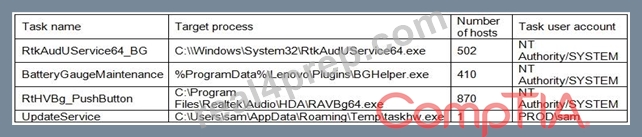
Which of the following actions should the hunter perform first based on the details above?
- A. Acquire a copy of taskhw.exe from the impacted host.
- B. Change the account that runs the taskhw.exe scheduled task.
- C. Perform a public search for malware reports on the taskhw.exe.
- D. Scan the enterprise to identify other systems with taskhdw.exe present.
Answer: A
NEW QUESTION # 66
An analyst has been asked to validate the potential risk of a new ransomware campaign that the Chief Financial Officer read about in the newspaper. The company is a manufacturer of a very small spring used in the newest fighter jet and is a critical piece of the supply chain for this aircraft. Which of the following would be the best threat intelligence source to learn about this new campaign?
- A. Cybersecuritv incident response team
- B. Blogs/forums
- C. Deep/dark web
- D. Information sharing organization
Answer: D
Explanation:
An information sharing organization is a group or network of organizations that share threat intelligence, best practices, or lessons learned related to cybersecurity issues or incidents. An information sharing organization can help security analysts learn about new ransomware campaigns or other emerging threats, as well as get recommendations or guidance on how to prevent, detect, or respond to them. An information sharing organization can also help security analysts collaborate or coordinate with other organizations in the same industry or region that may face similar threats or challenges.
NEW QUESTION # 67
Which of the following is the first step that should be performed when establishing a disaster recovery plan?
- A. Agree on the goals and objectives of the plan
- B. Determine the site to be used during a disaster
C Demonstrate adherence to a standard disaster recovery process - C. Identity applications to be run during a disaster
Answer: A
Explanation:
The first step that should be performed when establishing a disaster recovery plan is to agree on the goals and objectives of the plan. The goals and objectives of the plan should define what the plan aims to achieve, such as minimizing downtime, restoring critical functions, ensuring data integrity, or meeting compliance requirements. The goals and objectives of the plan should also be aligned with the business needs and priorities of the organization and be measurable and achievable.
NEW QUESTION # 68
An analyst reviews a recent government alert on new zero-day threats and finds the following CVE metrics for the most critical of the vulnerabilities:
CVSS: 3.1/AV:N/AC: L/PR:N/UI:N/S:C/C:H/I:H/A:H/E:U/RL:W/RC:R
Which of the following represents the exploit code maturity of this critical vulnerability?
- A. RC:R
- B. S:C
- C. E:U
- D. AC:L
- E. AV:N
Answer: C
Explanation:
The exploit code maturity of a vulnerability is indicated by the E metric in the CVSS temporal score. The value of U means that no exploit code is available or unknown. The other options are not related to the exploit code maturity, but to other aspects of the vulnerability, such as attack vector, scope, availability, and complexity.
NEW QUESTION # 69
A company patches its servers using automation software. Remote SSH or RDP connections are allowed to the servers only from the service account used by the automation software. All servers are in an internal subnet without direct access to or from the internet. An analyst reviews the following vulnerability summary: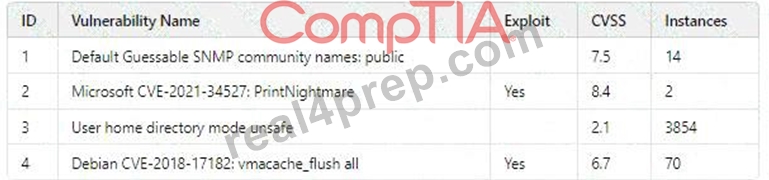
Which of the following vulnerability IDs should the analyst address first?
- A. 0
- B. 1
- C. 2
- D. 3
Answer: A
Explanation:
The vulnerability with the highest CVSS score and an active exploit is Microsoft CVE-2021-34527 (PrintNightmare). Although only present on two instances, its high severity (8.4) and exploitable nature make it a priority. PrintNightmare is a well-known remote code execution vulnerability, which can be a critical risk.
According to CompTIA CySA+ and vulnerability management practices, prioritizing based on severity and exploitability is essential, even over the number of instances. Other vulnerabilities listed are less severe or lack active exploitation.
NEW QUESTION # 70
SIMULATION
A systems administrator is reviewing the output of a vulnerability scan.
INSTRUCTIONS
Review the information in each tab.
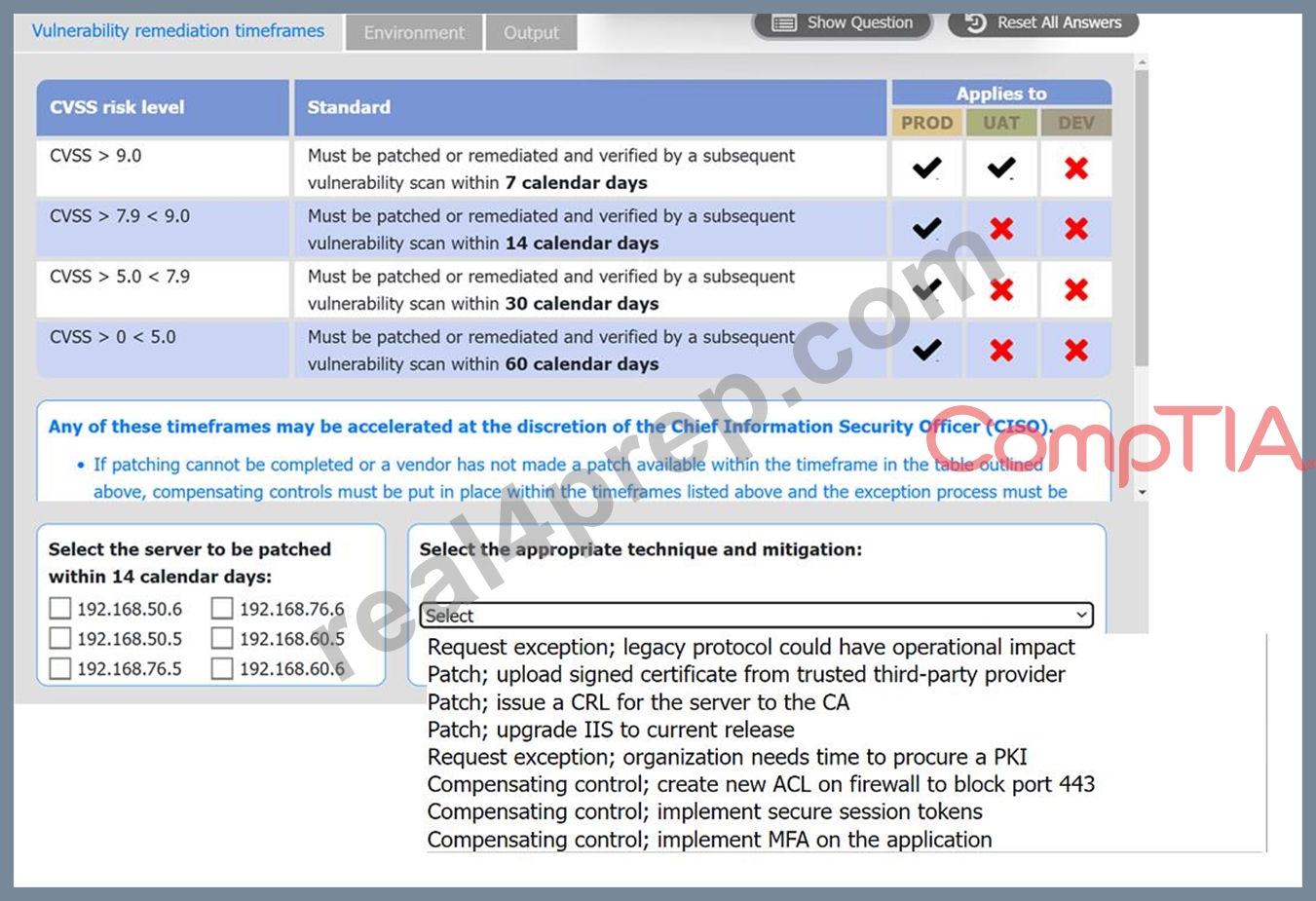
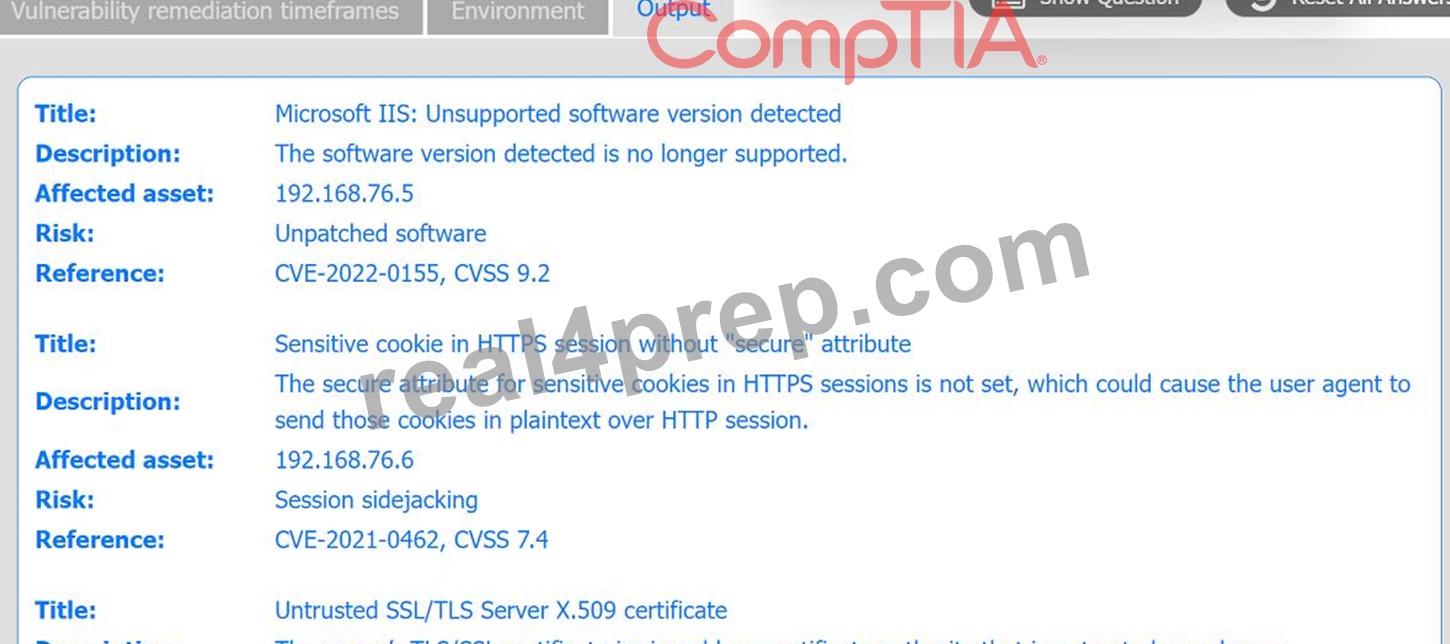
Based on the organization's environment architecture and remediation standards, select the server to be patched within 14 days and select the appropriate technique and mitigation.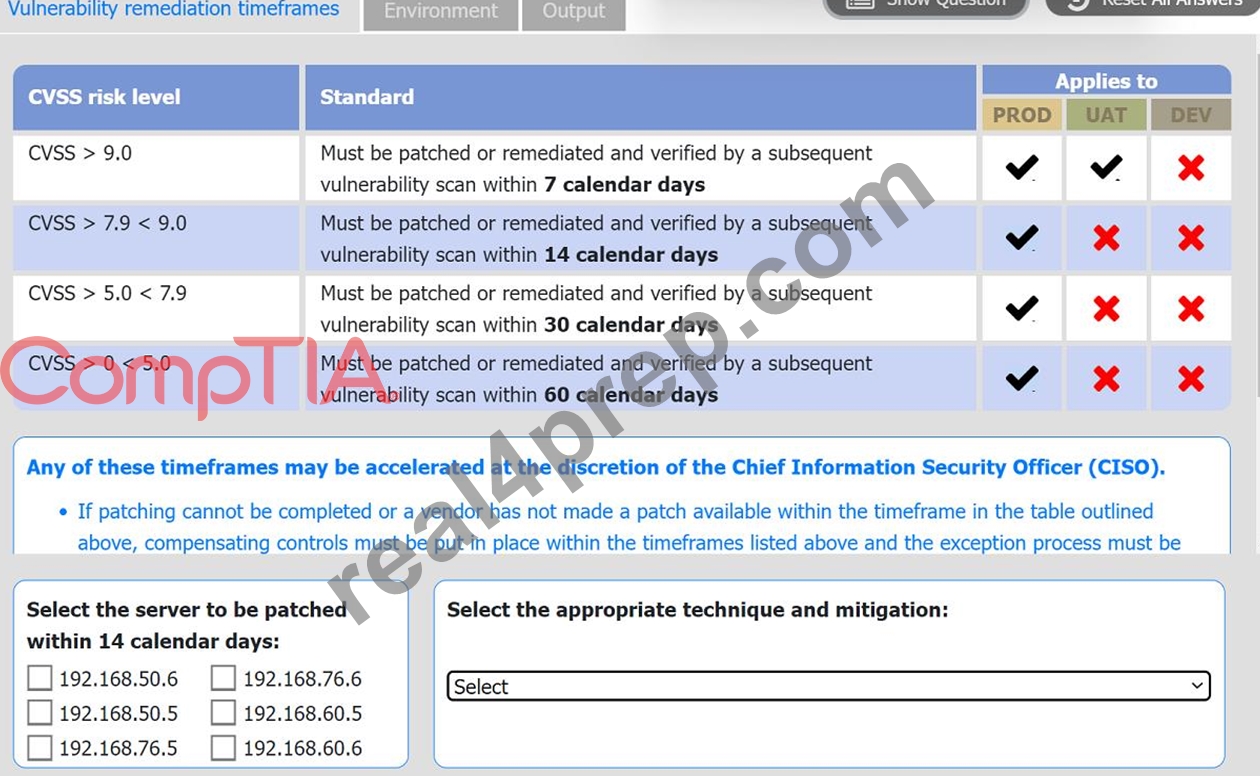
Answer:
Explanation:
see the explanation for step by step solution
Explanation:
Step 1: Reviewing the Vulnerability Remediation Timeframes
The remediation standards require servers to be patched based on their CVSS score:
CVSS > 9.0: Patch within 7 days
CVSS 7.9 - 9.0: Patch within 14 days
CVSS 5.0 - 7.9: Patch within 30 days
CVSS 0 - 5.0: Patch within 60 days
Step 2: Analyzing the Output Tab
From the Output tab:
Server 192.168.76.5 has a CVSS score of 9.2 for an unsupported Microsoft IIS version, indicating a critical vulnerability requiring a patch within 7 days.
Server 192.168.76.6 has a CVSS score of 7.4 for a missing secure attribute on HTTPS cookies, which falls in the 5.0 - 7.9 range, requiring a patch within 30 days.
Since the question asks for the server to be patched within 14 days, we need to focus on servers with CVSS 7.9 - 9.0:
None of the servers have a CVSS score that falls precisely in the 7.9 - 9.0 range.
However, 192.168.76.5, with a CVSS score of 9.2, has a vulnerability that necessitates a quick response and fits as it must be patched within the shortest timeframe (7 days, which includes 14 days).
The server that fits within a 14-day urgency, based on standard practices, would be 192.168.76.5.
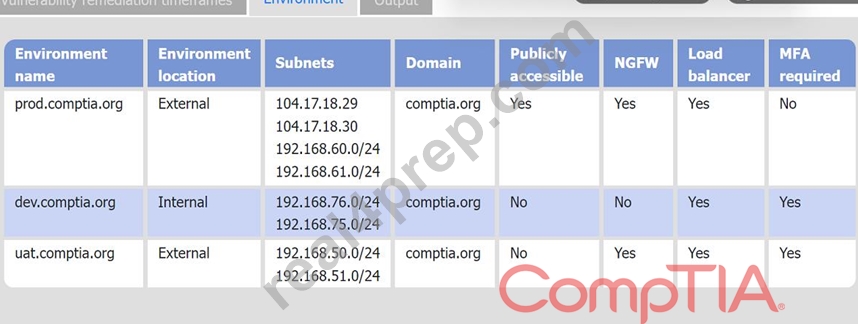
Step 3: Reviewing the Environment Tab
The Environment Tab provides additional context for 192.168.76.5:
It's in the dev environment, which is internal and not publicly accessible.
MFA is required, indicating security measures are already present.
Step 4: Selecting the Appropriate Technique and Mitigation
For 192.168.76.5, with the Microsoft IIS unsupported version:
Patch; upgrade IIS to the current release is the most suitable option, as upgrading IIS will resolve the unsupported software vulnerability by bringing it up-to-date with supported versions.
This technique addresses the root cause, which is the unpatched, outdated software.
Summary
Server to be patched within 14 calendar days: 192.168.76.5
Appropriate technique and mitigation: Patch; upgrade IIS to the current release This approach ensures that the most critical vulnerabilities are addressed promptly, maintaining security compliance.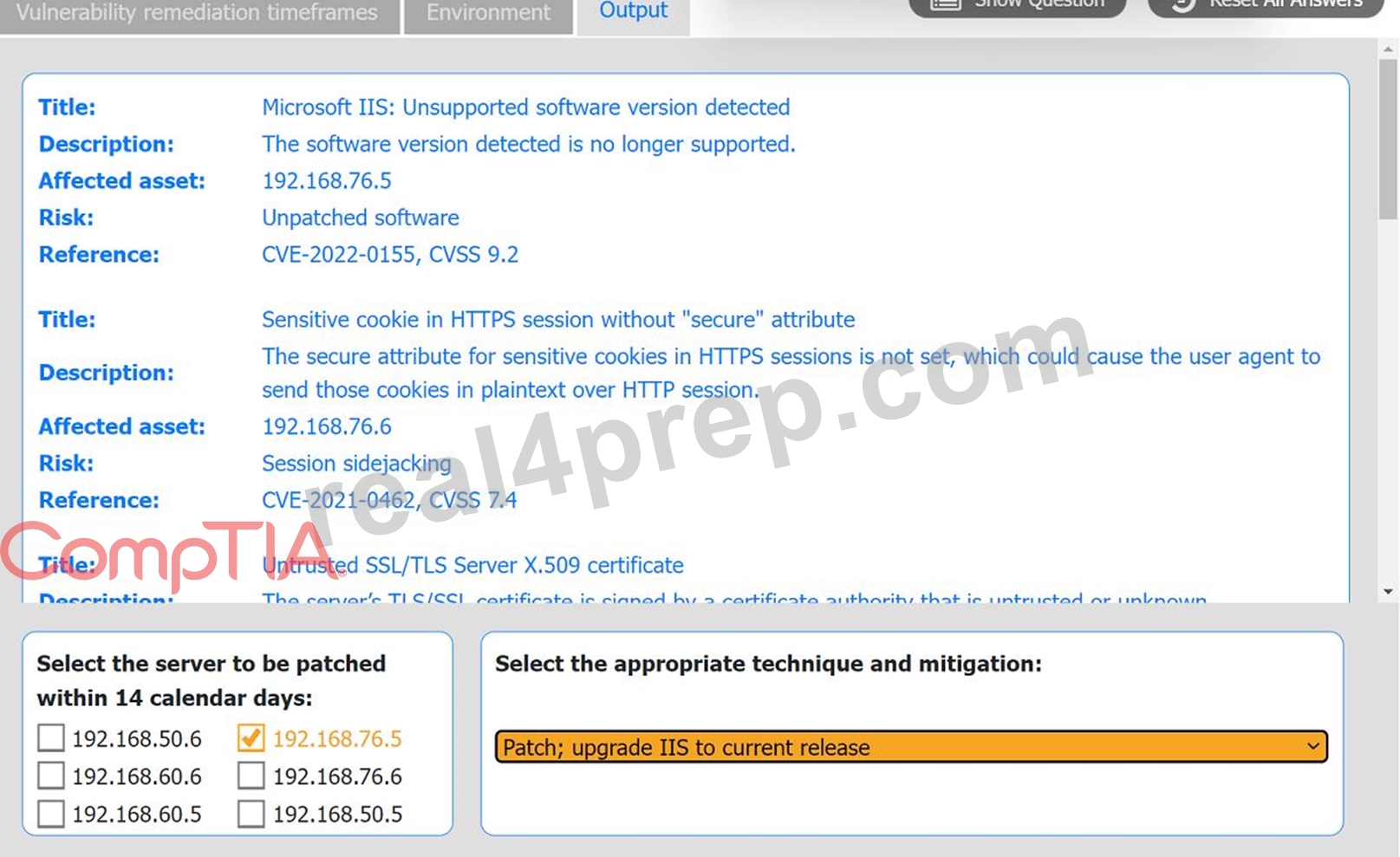
NEW QUESTION # 71
A cybersecurity team lead is developing metrics to present in the weekly executive briefs.
Executives are interested in knowing how long it takes to stop the spread of malware that enters the network. Which of the following metrics should the team lead include in the briefs?
- A. Mean time to contain
- B. Mean time between failures
- C. Mean time to remediate
- D. Mean time to detect
Answer: A
Explanation:
Mean time to contain is the metric that the cybersecurity team lead should include in the weekly executive briefs, as it measures how long it takes to stop the spread of malware that enters the network. Mean time to contain is the average time it takes to isolate and neutralize an incident or a threat, such as malware, from the time it is detected. Mean time to contain is an important metric for evaluating the effectiveness and efficiency of the incident response process, as well as the potential impact and damage of the incident or threat. A lower mean time to contain indicates a faster and more successful response, which can reduce the risk and cost of the incident or threat. Mean time to contain can also be compared with other metrics, such as mean time to detect or mean time to remediate, to identify gaps or areas for improvement in the incident response process.
NEW QUESTION # 72
......
Use Free CS0-003 Exam Questions that Stimulates Actual EXAM : https://prep4sure.real4prep.com/CS0-003-exam.html