


The real exam is a performance, and performances need rehearsal. Prep4away's timed test engines stage the Python Institute PCEP - Certified Entry-Level Python Programmer experience at home, PCEP-30-02 practice questions at a time.
Python Institute PCEP-30-02 Exam Syllabus Topics:
| Section | Weight | Objectives |
|---|---|---|
| Python Basics | 8% | - Comments and documentation - Python fundamentals and syntax - Variables and naming conventions - Literals: integer, float, string, boolean |
| Control Flow - Conditional Statements | 14% | - Nested conditionals - The pass statement - Comparison operators - if, elif, else statements |
| Data Collections - Lists | 20% | - List slicing and negative indices - Sorting lists (sorted(), list.sort()) - List operations: len(), min(), max(), sum() - List creation and indexing - List methods: append(), extend(), insert(), remove(), pop() - List comprehension basics |
| Functions and Exceptions | 10% | - Parameters and arguments - Default argument values - Built-in exceptions - Function definition and invocation - Variable scope (local vs global) - Exception handling: try, except, else, finally - Return values |
| Data Collections - Tuples and Dictionaries | 10% | - Adding and modifying dictionary entries - Tuple operations and indexing - Dictionary methods: keys(), values(), items(), get() - Tuple creation and immutability - Dictionary creation and access |
| Data Types and Operators | 12% | - Boolean values and logical operators - Type conversion functions (int(), float(), str(), bool()) - Numeric operators: +, -, *, /, //, %, ** - String operations and concatenation |
| Input/Output Operations | 8% | - print() function and formatting - sep and end parameters - f-strings and formatting - input() function |
| Control Flow - Loops | 18% | - break and continue statements - for loop with range() - while loop - Nested loops - else clause in loops |
PCEP-30-02 FAQ for Candidates Who Mean It
The PCEP-30-02 exam is Python Institute's formal test for the Python Institute PCEP certification, a credential at the Entry-Level (Beginner) level. It verifies that you can apply the Python Institute PCEP - Certified Entry-Level Python Programmer objectives in realistic, scenario-driven situations — the difference between having read about the work and being able to do it. It also connects to a broader certification path covering PCAP-31-03 (Certified Associate in Python Programming), so the study effort compounds beyond a single exam. That is why preparing through realistic questions beats re-reading chapters every time.
The Python Institute PCEP - Certified Entry-Level Python Programmer blueprint spans 8 domains, led by Data Collections - Lists (20%), Input/Output Operations (8%), and Control Flow - Conditional Statements (14%). Treat the percentages as a study budget: the heavier the domain, the larger its share of your week. The complete topic list sits in the exam topics section above — build your plan on it, not on guesswork.
The Python Institute PCEP - Certified Entry-Level Python Programmer exam packs 30 questions into 40 minutes. Turn that ratio into a plan before test day: minutes divided by questions gives your per-item budget, and anything consuming double its budget gets marked and revisited at the end. Practice the rhythm against a real timer — every Prep4away engine session enforces one — until finishing with spare review time is your default.
Python Institute PCEP - Certified Entry-Level Python Programmer requires 70% to pass, and every attempt costs $59.50 USD — retakes included, at full price. The smart economics are simple: drill with Prep4away practice questions until your timed scores clear the mark across several consecutive sessions, then book the seat. Over-preparation is cheaper than re-registration.
Python Institute lists the Python Institute PCEP - Certified Entry-Level Python Programmer question formats as: Single-choice, Multiple-choice, Fill-in-the-blank, Drag-and-drop. Format shapes strategy — locate the actual question sentence inside long scenario stems before reading details, and double-check every selection on multi-answer items. Prep4away's 44 practice questions exercise these formats so thoroughly that on exam day, only the content is unfamiliar.
You can sit the PCEP-30-02 exam in English. Choose whichever language keeps your comprehension fastest under the clock — slow reading is a hidden tax on every question. Testing in English? Daily sessions with Prep4away's English PCEP-30-02 practice questions double as focused terminology training.
The certification earned through the Python Institute PCEP - Certified Entry-Level Python Programmer exam stays valid for Lifetime (no expiration). Put the expiry date on your calendar the day you pass, and research the recertification path before it looms — a planned renewal is an errand, while an expired credential is a project. Python Institute sets these policies, so verify the current rules on the official certification page as your window approaches.
All three versions carry the same 44 expert-written questions — you are choosing a study environment, not a content tier:
- PDF version — printable, expert-prepared, instantly downloadable, readable anywhere and anytime. Includes 365 days of free updates and a free demo.
- Desktop Test Engine — Windows software simulating the real exam environment, with two practice modes, offline access, and unlimited installations.
- Online Test Engine — runs in any browser on Windows, Mac, Android, and iOS, with test history and performance review built in.
Plenty of candidates mix formats — the PDF for reading, an engine for timed rehearsal.
Yes. Prep4away's free Python Institute PCEP - Certified Entry-Level Python Programmer PDF demo contains real sample questions with complete verified answers, so you can judge the quality yourself. Every purchase includes 365 days of free updates, and renewing after expiry costs 50% of the regular price from your member zone. Inspect first — material this confident has nothing to hide.
Continuously. As Python Institute adjusts the Python Institute PCEP - Certified Entry-Level Python Programmer exam, our experts supplement and revise the bank to match, and customer feedback flows into the same loop. Updates are free for 365 days in your member zone; watch the New Releases section or the Prep4away newsletter, and re-verify your version 3-4 days before your exam. Expired products repurchase at 50% off to restart the service.
Our staff are professionally trained and available around the clock: free consultation whenever you need it, one-on-one remote guidance for installation or usage issues, and patient answers to content questions by email. On privacy, the rules are rigid — transactions are secured by McAfee security services, purchase information is never disclosed to third parties, and no spam or telemarketing follows your order.
Delivery first: your Python Institute PCEP - Certified Entry-Level Python Programmer practice questions are downloadable immediately and emailed within one minute of payment — if 2 hours pass, check spam and contact support. Install on as many computers as you like. If the exam goes wrong, the 100% Money Back Guarantee applies under clear conditions: take the corresponding exam within 60 days of purchase, and if you don't pass, submit a scanned enrollment slip and your official Score Report PDF within 2 days after the exam — full refunds are processed within 7 days. Not eligible: attempts within 3 days of purchase, exams never actually taken, free items, and expired orders; the candidate name must match the payer name. Prefer to keep preparing instead? Exchange for two free products of equal value and keep your update service.
Python Institute PCEP - Certified Entry-Level Python Programmer Sample Questions:
What is true about tuples? (Select two answers.)
- A. The len { } function cannot be applied to tuples.
- B. Tuples are immutable, which means that their contents cannot be changed during their lifetime.
- C. Tuples can be indexed and sliced like lists.
- D. An empty tuple is written as { } .
Correct Answer: B,C 🗳️
Explanation: Only visible for Prep4away members. You can sign-up / login (it's free).
What is the expected result of running the following code?
- A. The code raises an unhandled exception.
- B. The code prints 2
- C. The code prints 0
- D. The code prints 1 .
Correct Answer: A 🗳️
Explanation: Only visible for Prep4away members. You can sign-up / login (it's free).
What is the expected output of the following code?
- A. 2
- B. 3
- C. 0
- D. 1
Correct Answer: D 🗳️
Explanation: Only visible for Prep4away members. You can sign-up / login (it's free).
Assuming that the following assignment has been successfully executed:
Which of the following expressions evaluate to True? (Select two expressions.)
- A. the_list. index {'1'} -- 0
- B. 1.1 in the_list |1:3 |
- C. len (the list [0:2]} <3
- D. the_List.index {"1"} in the_list
Correct Answer: A,C 🗳️
Explanation: Only visible for Prep4away members. You can sign-up / login (it's free).
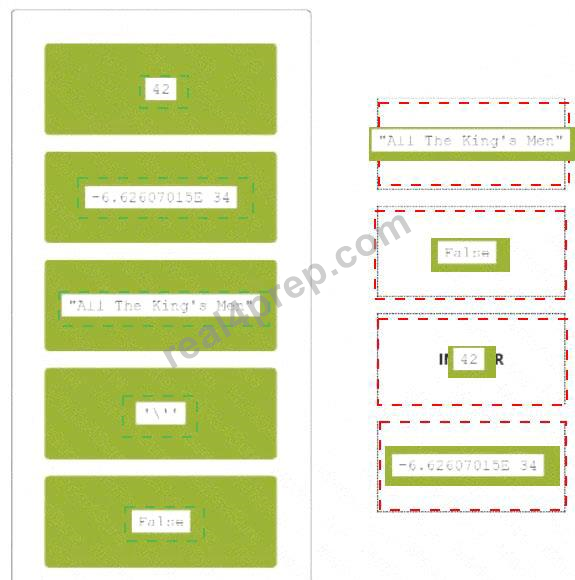
Drag and drop the literals to match their data type names.
Correct Answer:
Explanation:
One possible way to drag and drop the literals to match their data type names is:
* STRING: "All The King's Men"
* BOOLEAN: False
* INTEGER: 42
* FLOAT: -6.62607015E-34
A literal is a value that is written exactly as it is meant to be interpreted by the Python interpreter. A data type is a category of values that share some common characteristics or operations. Python has four basic data types: string, boolean, integer, and float.
A string is a sequence of characters enclosed by either single or double quotes. A string can represent text, symbols, or any other information that can be displayed as text. For example, "All The King's Men" is a string literal that represents the title of a novel.
A boolean is a logical value that can be either True or False. A boolean can represent the result of a comparison, a condition, or a logical operation. For example, False is a boolean literal that represents the opposite of True.
An integer is a whole number that can be positive, negative, or zero. An integer can represent a count, an index, or any other quantity that does not require fractions or decimals. For example, 42 is an integer literal that represents the answer to life, the universe, and everything.
A float is a number that can have a fractional part after the decimal point. A float can represent a measurement, a ratio, or any other quantity that requires precision or approximation. For example,
-6.62607015E-34 is a float literal that represents the Planck constant in scientific notation.
You can find more information about the literals and data types in Python in the following references:
* [Python Data Types]
* [Python Literals]
* [Python Basic Syntax]
Viewing page 1 out of 9 pages.
Viewing questions 1-5 out of 44 questions.


