


FC0-U61 Dumps for Pass Guaranteed - Pass FC0-U61 Exam 2024
FC0-U61 Exam Dumps - Try Best FC0-U61 Exam Questions from Training Expert Prep4away
NEW QUESTION # 92
Which of the following types of encryptions would BEST protect a laptop computer in the event of theft?
- A. HTTPS
- B. Email
- C. Disk
- D. VPN
Answer: C
Explanation:
Disk encryption is a type of encryption that protects the entire contents of a hard drive or a removable storage device by using a secret key to scramble the data. Disk encryption would best protect a laptop computer in the event of theft because it would prevent unauthorized access to the data on the laptop. Email, VPN, and HTTPS are not types of encryption that protect the entire contents of a laptop computer. References: CompTIA IT Fundamentals+ Study Guide: Exam FC0-U61, Second Edition, Chapter 8: Security Concepts, page 308.
NEW QUESTION # 93
Which of the following is an example of multifactor authentication?
- A. Smart card and PIN
- B. Password and passphrase
- C. Hardware token and smartphone
- D. Fingerprint and retina scan
Answer: A
Explanation:
Smart card and PIN are the examples of multifactor authentication. Multifactor authentication is a security method that requires two or more factors or pieces of evidence to verify the identity of a user or device. The factors are usually classified into three categories: something you know (such as a password or PIN), something you have (such as a smart card or token), or something you are (such as a fingerprint or retina scan). Multifactor authentication provides stronger security than single-factor authentication because it reduces the risk of compromise if one factor is lost or stolen. References : The Official CompTIA IT Fundamentals (ITF+) Study Guide (FC0-U61), page 207.
NEW QUESTION # 94
Which of the following is the exact number of bytes in a gigabyte?
- A. 1,099,511,627,776 bytes
- B. 1,048,576 bytes
- C. 1,024 bytes
- D. 1,073,741,824 bytes
Answer: D
Explanation:
Explanation
The exact number of bytes in a gigabyte is 1.073.741.824 bytes. A byte is a unit of digital information that consists of eight bits. A bit is a binary digit that can have one of two values: 0 or 1. A byte can store one character, such as a letter, a number, or a symbol. A gigabyte is a unit of digital information that consists of
1.073.741.824 bytes or 1.024 megabytes. A megabyte is a unit of digital information that consists of 1.048.576 bytes or 1.024 kilobytes. A kilobyte is a unit of digital information that consists of 1.024 bytes. These units are based on the binary system, which uses powers of two to represent values. However, there are also decimal units that use powers of ten to represent values, such as gigabyte (GB), megabyte (MB), and kilobyte (KB).
These units are often used by storage devices and network services to measure capacity or speed. In this case, one gigabyte (GB) equals 1 billion bytes or 1.000 megabytes (MB). One megabyte (MB) equals 1 million bytes or 1.000 kilobytes (KB). One kilobyte (KB) equals 1 thousand bytes. References: The Official CompTIA IT Fundamentals (ITF+) Student Guide (Exam FC0-U61), Chapter 2: IT Concepts and Terminology
NEW QUESTION # 95
A user browses to a website. Before the page opens, the user receives a message that the site is not secure. Which of the following caused this message?
- A. Malware
- B. Proxy
- C. Script
- D. Certificate
Answer: D
Explanation:
A website that is not secure means that the connection between the user's browser and the web server is not encrypted or authenticated. This can expose the user's data to interception, modification, or impersonation by attackers. One way to secure a website is to use HTTPS (Hypertext Transfer Protocol Secure), which is a protocol that encrypts and verifies the data exchanged between the browser and the server. HTTPS relies on certificates, which are digital documents that contain information about the identity and public key of the website owner. Certificates are issued by trusted authorities called certificate authorities (CAs), which verify the legitimacy of the website owner before issuing a certificate. When a user browses to a website that uses HTTPS, the browser checks the certificate to ensure that it is valid, signed by a CA, and matches the website's domain name. If any of these checks fail, the browser will display a warning message that the site is not secure, and advise the user not to proceed or enter any sensitive information.
NEW QUESTION # 96
Which of the following is the most secure fllesystem?
- A. exFAT
- B. NTFS
- C. NFS
- D. FAT32
Answer: B
Explanation:
Explanation
NTFS stands for New Technology File System, which is the most secure file system among the given options.
NTFS is a file system that was developed by Microsoft for Windows operating systems. NTFS supports features such as encryption, compression, permissions, quotas, and auditing, which enhance the security and performance of the file system. FAT32 stands for File Allocation Table 32, which is a file system that was developed by Microsoft for older versions of Windows and DOS operating systems. FAT32 does not support encryption, compression, permissions, quotas, or auditing, and it has limitations on the size of files and partitions that it can handle. NFS stands for Network File System, which is a file system that was developed by Sun Microsystems for Unix and Linux operating systems. NFS allows users to access files on remote servers as if they were local files, but it does not support encryption or compression. exFAT stands for Extended File Allocation Table, which is a file system that was developed by Microsoft for flash drives and other removable media. exFAT supports larger files and partitions than FAT32, but it does not support encryption, compression, permissions, quotas, or auditing. References: The Official CompTIA IT Fundamentals (ITF+) Student Guide (Exam FC0-U61), Chapter 4: Operating System Fundamentals
NEW QUESTION # 97
A company executive wants to view company training videos from a DVD. Which of the following components would accomplish this task?
- A. Solid state drive
- B. Flash drive
- C. Optical drive
- D. Hard disk drive
Answer: C
Explanation:
Explanation
An optical drive is a component that can accomplish the task of viewing company training videos from a DVD. An optical drive is a device that can read and write data from optical discs, such as CDs, DVDs, or Blu-ray discs. An optical drive uses a laser beam to access the data stored on the disc. An optical drive can play video or audio files from optical discs, as well as install software or store data.
A hard disk drive (HDD) is a component that can store large amounts of data on magnetic platters, but it cannot read or write data from optical discs. A solid state drive (SSD) is a component that can store data on flash memory chips, but it cannot read or write data from optical discs. A flash drive is a component that can store data on flash memory chips and connect to a USB port, but it cannot read or write data from optical discs.
NEW QUESTION # 98
Which of the following BEST describes a technology that allows multiple users to create and edit reports at the same time?
- A. Text file on a shared drive
- B. Informational intranet page
- C. Managed relational database
- D. Locally installed productivity software
Answer: C
NEW QUESTION # 99
Which of the following is an example of information a company would ask employees to handle in a sensitive manner?
- A. Customer service number
- B. Customer date of birth
- C. Company social media screen name
- D. The first and last name of the Chief Executive Officer (CEO)
Answer: B
NEW QUESTION # 100
A new device has been installed on a wired network and can be accessed via the LAN but cannot be accessed remotely.
Which of the following is the most likely cause?
- A. Improper switch configuration
- B. Misconfigured access point
- C. Firewall settings
- D. Incorrect IP address
Answer: C
Explanation:
The most likely cause of the device being accessible via the LAN but not remotely is firewall settings. A firewall is a software or hardware device that filters incoming and outgoing network traffic based on rules and policies. A firewall can block or allow traffic based on factors such as source and destination IP addresses, ports, protocols, and applications. If the firewall settings are too restrictive or misconfigured, they may prevent remote access to the device from outside the LAN. Improper switch configuration is unlikely to cause this issue, as switches are devices that forward packets within the same network segment based on MAC addresses. Switches do not block or filter traffic based on IP addresses or ports. Incorrect IP address is unlikely to cause this issue either, as an incorrect IP address would prevent the device from communicating with any other device on the network, not just remotely. Misconfigured access point is also unlikely to cause this issue, as access points are devices that provide wireless connectivity to the network. If the device is connected via a wired network, the access point is irrelevant. References: CompTIA IT Fundamentals (ITF+) Study Guide: Exam FC0-U61, Second Edition, Chapter 3: Infrastructure, page 95
NEW QUESTION # 101
A technician is troubleshooting an error message and tests the same program on a separate, identical machine. Which of the following troubleshooting methodology steps is this an example of?
- A. Duplicate the problem
- B. Gather information
- C. Optical
- D. Divide and conquer
Answer: A
NEW QUESTION # 102
Which of the following would be the easiest component to upgrade on a laptop that is experiencing slow performance?
- A. CPU
- B. RAM
- C. Motherboard
- D. GPU
Answer: B
Explanation:
Explanation
The easiest component to upgrade on a laptop that is experiencing slow performance is RAM. RAM stands for Random Access Memory, which is a type of volatile memory that stores data temporarily while the computer is running. RAM allows fast access and modification of data by the CPU, but it loses its contents when the power is turned off. Upgrading RAM can improve the performance of a laptop by increasing the amount of data that can be stored and processed at the same time, reducing the need for swapping or paging to the hard disk. Upgrading RAM on a laptop is usually easy, as it only requires opening a small panel on the back or side of the laptop and inserting or replacing the RAM modules into the slots. The motherboard is not the easiest component to upgrade on a laptop that is experiencing slow performance, but rather one of the most difficult components to upgrade. The motherboard is the main circuit board of a computer that connects and controls all the other components, such as the CPU, RAM, GPU, etc. Upgrading the motherboard can improve the performance of a laptop by supporting newer or faster components, but it is also very complex, costly, and risky. Upgrading the motherboard on a laptop may require replacing or reconfiguring many other components, as well as ensuring compatibility and stability with the operating system and drivers. The GPU is not the easiest component to upgrade on a laptop that is experiencing slow performance, but rather one of the most difficult components to upgrade. The GPU stands for Graphics Processing Unit, which is a specialized component of a computer that handles graphics and image processing. Upgrading the GPU can improve the performance of a laptop by increasing the speed and quality of rendering graphics, especially for gaming or video editing applications. However, upgrading the GPU on a laptop is usually very hard or impossible, as most laptops have integrated GPUs that are soldered to the motherboard or CPU and cannot be replaced or upgraded. The CPU is not the easiest component to upgrade on a laptop that is experiencing slow performance, but rather one of the most difficult components to upgrade. The CPU stands for Central Processing Unit, which is the main component of a computer that executes instructions and performs calculations. Upgrading the CPU can improve the performance of a laptop by increasing the speed and efficiency of processing data, especially for multitasking or complex applications. However, upgrading the CPU on a laptop is usually very hard or impossible, as most laptops have integrated CPUs that are soldered to the motherboard and cannot be replaced or upgraded. References: The Official CompTIA IT Fundamentals (ITF+) Student Guide (Exam FC0-U61), Chapter 1: IT Fundamentals
NEW QUESTION # 103
Which of the following filesystems is compatible with the greatest number of operating systems?
- A. NTFS
- B. ext4
- C. HFS
- D. FAT32
Answer: D
Explanation:
Explanation
The filesystem that is compatible with the greatest number of operating systems is FAT32. FAT32 stands for File Allocation Table 32-bit, which is a filesystem that organizes data into clusters or groups of sectors on a storage device, such as a hard disk or a flash drive. FAT32 uses a 32-bit table to keep track of the location and status of each cluster. FAT32 can support volumes up to 2 TB and files up to 4 GB in size. FAT32 is compatible with most operating systems, such as Windows, Linux, Mac OS, Android, etc., as well as most devices, such as cameras, printers, game consoles, etc. FAT32 is one of the oldest and simplest filesystems, but it also has some limitations and drawbacks, such as fragmentation, waste of space, lack of security features, etc. ext4 is not the filesystem that is compatible with the greatest number of operating systems, but rather a filesystem that is mainly used by Linux operating systems. ext4 stands for Fourth Extended Filesystem, which is a filesystem that organizes data into blocks or groups of sectors on a storage device. ext4 uses an inode table to keep track of the location and attributes of each file or directory. ext4 can support volumes up to 1 EB and files up to 16 TB in size. ext4 has many features and advantages over FAT32, such as journaling, extents, subdirectories, encryption, etc., but it also has limited compatibility with other operating systems, such as Windows or Mac OS. NTFS is not filesystem that is compatible with greatest number of operating systems, but rather filesystem that is mainly used by Windows operating systems. NTFS stands for New Technology File System, which is filesystem that organizes data into clusters or groups of sectors on storage device. NTFS uses Master File Table (MFT) to keep track of location and attributes of each file or directory. NTFS can support volumes up to 256 TB and files up to 256 TB in size. NTFS has many features and advantages over FAT32, such as journaling, compression, encryption, security, etc., but it also has limited compatibility with other operating systems, such as Linux or Mac OS. HFS is not filesystem that is compatible with greatest number of operating systems, but rather filesystem that is mainly used by Mac OS operating systems. HFS stands for Hierarchical File System, which is filesystem that organizes data into blocks or groups of sectors on storage device. HFS uses catalog file to keep track of location and attributes of each file or directory. HFS can support volumes up to 2 TB and files up to 2 GB in size. HFS has some features and advantages over FAT32, such as resource forks, aliases, etc., but it also has some limitations and drawbacks, such as fragmentation, waste of space, lack of security features, etc. HFS also has limited compatibility with other operating systems, such as Windows or Linux. References: The Official CompTIA IT Fundamentals (ITF+) Student Guide (Exam FC0-U61), Chapter 4: Operating System Fundamentals1
NEW QUESTION # 104
Which of the following storage types uses platters to store data?
- A. Solid-state drive
- B. Optical drive
- C. Hard drive
- D. Flash drive
Answer: C
Explanation:
Explanation
A hard drive, also known as a hard disk drive (HDD), is a type of storage device that uses one or more rotating platters coated with magnetic material to store data. The platters are accessed by read/write heads that move across the surface of the platters as they spin. The data is stored as tiny magnetic regions on the platters, which can be changed or read by the heads. Hard drives are non-volatile, meaning they retain data even when power is off. Hard drives offer large storage capacity, low cost per gigabyte, and fast data transfer rates compared to other storage types. However, they are also prone to mechanical failures, noise, heat, and physical damage
NEW QUESTION # 105
Within a database, which of the following would be the best access method to use to display a subset of a table?
- A. UPDATE
- B. SELECT
- C. DROP
- D. INSERT
Answer: B
Explanation:
Explanation
The SELECT statement is used to query a database and retrieve a subset of data that matches the specified criteria. For example, SELECT * FROM Customers WHERE City = 'London' will return all the records from the Customers table where the City column is equal to 'London'. The SELECT statement can also be used to join multiple tables, perform calculations, sort and group data, and apply filters and functions. The SELECT statement is one of the most commonly used SQL commands and is essential for manipulating and analyzing data in a database.
NEW QUESTION # 106
Consider the following statements: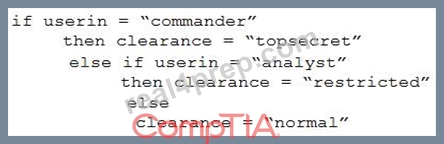
Given the input (userin) of "analyst", to which of the following would the clearance variable be set?
- A. normal
- B. restricted
- C. analyst
- D. topsecret
Answer: B
Explanation:
Explanation
Float is a data type that can store decimal or fractional numbers, such as 3.14, 0.5, or -2.75. Float would be the best data type to use for storing monetary values because monetary values often involve decimals, such as
$1.99, 0.25,or-5.50. Integer is a data type that can only store whole numbers, such as 1, 0, or -2. Integer would not be suitable for storing monetary values that have decimals. The other options are not data types that can store numerical values. References: CompTIA IT Fundamentals+ Study Guide: Exam FC0-U61, Second Edition, Chapter 4: Programming Concepts and Data Structures, page 146.
NEW QUESTION # 107
A small company wants to set up a server that is accessible from the company network as well as the Internet.
Which of the following is MOST important to determine before allowing employees to access the server remotely?
- A. The geographical location of the employees
- B. The employees' home ISP speeds
- C. The quality of the computer used to connect
- D. A security method of allowing connections
Answer: D
Explanation:
Explanation
The most important factor to determine before allowing employees to access the server remotely is a security method of allowing connections. This means that the company needs to implement a way of verifying the identity and authorization of the employees who want to connect to the server from outside the company network or the internet. A security method of allowing connections can include using passwords, tokens, certificates, VPNs, firewalls, or encryption. A security method of allowing connections can prevent unauthorized access, data breaches, malware infections, or other cyberattacks on the server1415. References := CompTIA IT Fundamentals (ITF+) Study Guide, 2nd Edition, Chapter 6: Security3; Remote Access Security Best Practices - Cisco Meraki
NEW QUESTION # 108
When editing a document, which of the following describes where the changes are located before they are saved to permanent storage?
- A. CPU
- B. SSD
- C. RAM
- D. GPU
Answer: C
Explanation:
Explanation
RAM stands for Random Access Memory, which is where the changes are located before they are saved to permanent storage when editing a document. RAM is a type of volatile memory that stores data temporarily while the computer is running. RAM allows fast access and modification of data by the CPU, but it loses its contents when the power is turned off. SSD stands for Solid State Drive, which is a type of permanent storage that stores data persistently even when the power is turned off. SSD uses flash memory chips to store data, which offer faster performance and lower power consumption than traditional hard disk drives (HDDs). CPU stands for Central Processing Unit, which is the main component of a computer that executes instructions and performs calculations. CPU does not store data, but it uses registers and cache memory to hold data temporarily during processing. GPU stands for Graphics Processing Unit, which is a specialized component of a computer that handles graphics and image processing. GPU does not store data, but it uses dedicated memory to hold graphics data temporarily during rendering. References: The Official CompTIA IT Fundamentals (ITF+) Student Guide (Exam FC0-U61), Chapter 1: IT Fundamentals
NEW QUESTION # 109
A product advertising kiosk at a mall is set up using a thin client without a hard drive and is running a web application managed and updated through an internet connection. Which of the following application delivery methods is most likely being used for the kiosk?
- A. Local network-hosted
- B. Hybrid-installed
- C. Cloud-hosted
- D. Locally installed
Answer: C
Explanation:
Explanation
The application delivery method that is most likely being used for the kiosk is cloud-hosted. Cloud-hosted is a type of application delivery method that involves running and accessing an application from a remote server or service over the internet. Cloud-hosted applications do not require installation or storage on the local device, but only a web browser or a client software to connect to the application. Cloud-hosted applications can provide benefits such as scalability, availability, security, and automatic updates. A product advertising kiosk at a mall that is set up using a thin client without a hard drive and is running a web application managed and updated through an internet connection is most likely using a cloud-hosted application delivery method, as it does not need any local resources or maintenance for the application. Local network-hosted is not the application delivery method that is most likely being used for the kiosk, but rather a type of application delivery method that involves running and accessing an application from a server or a device within the same local area network (LAN) as the client device. Local network-hosted applications require installation or storage on the server or device that hosts the application, but not on the client device. Local network-hosted applications can provide benefits such as speed, reliability, and control. A product advertising kiosk at a mall that is set up using a thin client without a hard drive and is running a web application managed and updated through an internet connection is not likely using a local network-hosted application delivery method, as it would need to be connected to a server or device within the same LAN as the kiosk. Hybrid-installed is not the application delivery method that is most likely being used for the kiosk, but rather a type of application delivery method that involves running and accessing an application from both a local device and a remote server or service over the internet. Hybrid-installed applications require partial installation or storage on the local device, as well as a web browser or a client software to connect to the remote part of the application.
Hybrid-installed applications can provide benefits such as flexibility, functionality, and performance. A product advertising kiosk at a mall that is set up using a thin client without a hard drive and is running a web application managed and updated through an internet connection is not likely using a hybrid-installed application delivery method, as it would need some local resources for the application. Locally installed is not the application delivery method that is most likely being used for the kiosk, but rather a type of application delivery method that involves running and accessing an application from the local device only. Locally installed applications require full installation or storage on the local device, but do not need any web browser or client software to connect to the internet. Locally installed applications can provide benefits such as offline access, customization, and compatibility. A product advertising kiosk at a mall that is set up using a thin client without a hard drive and is running a web application managed and updated through an internet connection is not likely using a locally installed application delivery method, as it would need a hard drive or other storage device for the application. References: The Official CompTIA IT Fundamentals (ITF+) Student Guide (Exam FC0-U61), Chapter 4: Operating System Fundamentals1
NEW QUESTION # 110
Which of the following statements BEST describes binary?
- A. A notational system used to represent a storage unit of measurement
- B. A notational system used to represent an "on" or "off" state
- C. A notational system used to represent Internet protocol addressing
- D. A notational system used to represent media access control
Answer: B
Explanation:
Binary is a notational system used to represent an "on" or "off" state in digital devices or systems. Binary uses only two symbols: 0 (off) and 1 (on). Binary is also known as base 2 notation, because each symbol represents a power of 2. Binary is the fundamental building block of all computer operations and data storage, as it can encode any type of information using sequences of bits (binary digits)1112. References := CompTIA IT Fundamentals (ITF+) Study Guide, 2nd Edition, Chapter 2: Computing Basics3; What is Binary? - Definition from Techopedia
NEW QUESTION # 111
A computer user is downloading software from the Internet and notices the following at the end of the install file: "...x86.exe". Which of the following statements BEST represents what the "...x86.exe" means in the installation file?
- A. x86 only supports an installation on a 64-bit CPU architecture.
- B. x86 only supports an installation on a 32-bit CPU architecture.
- C. x86 supports an installation on a 16-bit CPU architecture.
- D. x86 supports an installation on a 32-bit and a 64-bit CPU architecture.
Answer: B
NEW QUESTION # 112
A systems administrator is setting up a new server using RAID technology. If one hard drive in the array fails, the data is stored on another drive, preventing data loss. Which of the following business continuity concepts does this explain?
- A. Fault tolerance
- B. Data restoration
- C. Restoring access
- D. File backup
Answer: A
NEW QUESTION # 113
Ann, the president of a company, has requested assistance with choosing the appropriate Internet connectivity for her home. The home is in a remote location and has no connectivity to existing infrastructure. Which of the following Internet service types should MOST likely be used?
- A. DSL
- B. Cable
- C. Fiber
- D. Satellite
Answer: D
Explanation:
Explanation
Satellite would be the best choice for Internet service for a home in a remote location that has no connectivity to existing infrastructure. Satellite Internet service uses satellites in orbit to provide wireless Internet access to users who have a satellite dish installed at their location. Satellite Internet service can cover areas where other types of Internet service are not available or reliable, such as rural or remote locations. Satellite Internet service can offer high-speed broadband connections, but it may also have drawbacks such as high latency, weather interference, and data caps. References : The Official CompTIA IT Fundamentals (ITF+) Study Guide (FC0-U61), page 168.
NEW QUESTION # 114
......
Latest 100% Passing Guarantee - Brilliant FC0-U61 Exam Questions PDF: https://prep4sure.real4prep.com/FC0-U61-exam.html