


UPDATED [2024] Pass CyberArk Secret-Sen Exam in First Attempt Guaranteed
Pass Secret-Sen Exam Latest Practice Questions
CyberArk Secret-Sen Certification Exam is recognized globally as a benchmark for expertise in secrets management. CyberArk Sentry - Secrets Manager certification demonstrates an individual's knowledge and proficiency in the CyberArk Secrets Manager, making them a valuable asset to any organization. Additionally, this certification enables professionals to stay up-to-date with the latest trends and technologies in secrets management.
NEW QUESTION # 37
How many Windows and Linux servers are required for a minimal Conjur deployment that integrates with an existing CyberArk PAM Vault environment, supports high availability, and is redundant across two geographically disparate regions?
- A. 5 Linux servers, 2 Windows servers
- B. 3 Linux servers, 1 Windows server
- C. 10 Linux servers, 2 Windows server
- D. 9 Linux servers, 2 Windows servers
Answer: D
Explanation:
Explanation
This is the correct answer because a minimal Conjur deployment that integrates with an existing CyberArk PAM Vault environment, supports high availability, and is redundant across two geographically disparate regions requires the following servers:
2 Linux servers for the Conjur master cluster, one in each region. The master cluster consists of a leader and a standby node that can automatically failover in case of a leader failure. The leader node performs read/write operations on the Conjur database and policy engine, while the standby node replicates the leader data and can be promoted to leader if needed. The master cluster also hosts the Conjur UI and API endpoints.
4 Linux servers for the Conjur follower clusters, two in each region. The follower clusters consist of one or more follower nodes that perform read-only operations on the Conjur database and policy engine, such as authentication, authorization, and secret retrieval. The follower clusters are horizontally scalable and can be configured behind a load balancer to handle high volumes of requests from applications and clients. The follower clusters also host the Conjur Synchronizer service, which synchronizes secrets from the CyberArk PAM Vault to the Conjur database.
2 Linux servers for the Conjur seed fetcher service, one in each region. The seed fetcher service is a utility that runs on a separate server and periodically fetches the Conjur seed files from the master cluster and distributes them to the follower clusters. The seed files contain the configuration and encryption keys that are required to join a follower node to the Conjur cluster. The seed fetcher service ensures that the follower clusters are always updated with the latest seed files and can join the Conjur cluster without manual intervention.
2 Windows servers for the CyberArk Central Credential Provider (CCP), one in each region. The CCP is a component that provides secure and centralized credential management for applications and clients that need to access secrets from the CyberArk PAM Vault. The CCP exposes a web service interface that allows applications and clients to request credentials based on their identity and permissions. The CCP integrates with the Conjur Synchronizer service to retrieve the secrets from the Conjur database and cache them locally for faster access.
Therefore, the total number of servers required for this deployment is 9 Linux servers and 2 Windows servers. This deployment architecture is based on the Conjur documentation1 and the Conjur training course2.
NEW QUESTION # 38
You are setting up a Kubernetes integration with Conjur. With performance as the key deciding factor, namespace and service account will be used as identity characteristics.
Which authentication method should you choose?
- A. API key authentication
- B. Connect (OIDC) authentication
- C. Certificate-based authentication
- D. JWT-based authentication
Answer: D
Explanation:
Explanation
According to the CyberArk Sentry Secrets Manager documentation, JWT-based authentication is the recommended method for authenticating Kubernetes pods with Conjur. JWT-based authentication uses JSON Web Tokens (JWTs) that are issued by the Kubernetes API server and signed by its private key. The JWTs contain the pod's namespace and service account as identity characteristics, which are verified by Conjur against a policy that defines the allowed namespaces and service accounts. JWT-based authentication is fast, scalable, and secure, as it does not require any additional certificates, secrets, or sidecars to be deployed on the pods. JWT-based authentication also supports rotation and revocation of the Kubernetes API server's private key, which enhances the security and resilience of the authentication process.
Certificate-based authentication is another method for authenticating Kubernetes pods with Conjur, but it is not the best option for performance. Certificate-based authentication uses X.509 certificates that are generated by a Conjur CA service and injected into the pods as Kubernetes secrets. The certificates contain the pod's namespace and service account as identity characteristics, which are verified by Conjur against a policy that defines the allowed namespaces and service accounts. Certificate-based authentication is secure and reliable, but it requires more resources and steps to generate, inject, and manage the certificates and secrets.
Certificate-based authentication also does not support rotation and revocation of the certificates, which may pose a security risk if the certificates are compromised or expired.
API key authentication and Connect (OIDC) authentication are not valid methods for authenticating Kubernetes pods with Conjur. API key authentication is used for authenticating hosts, users, and applications that have a Conjur identity and an API key. Connect (OIDC) authentication is used for authenticating users and applications that have an OpenID Connect identity and a token. These methods are not suitable for Kubernetes pods, as they do not use the pod's namespace and service account as identity characteristics, and they require additional secrets or tokens to be stored and managed on the pods. References: = JWT Authenticator | CyberArk Docs; Certificate Authenticator | CyberArk Docs; API Key Authenticator | CyberArk Docs; Connect Authenticator | CyberArk Docs
NEW QUESTION # 39
What is a possible Conjur node role change?
- A. A Leader may be demoted to a Standby in the event of a failover.
- B. A Follower may be promoted to a Leader.
- C. A Standby may be promoted to a Leader.
- D. A Standby may be promoted to a Follower.
Answer: C
Explanation:
Explanation
According to the CyberArk Sentry Secrets Manager documentation, Conjur is a secrets management solution that consists of a leader node and one or more follower nodes. The leader node is responsible for managing the secrets, policies, and audit records, while the follower nodes are read-only replicas that can serve secrets requests from applications. Additionally, Conjur supports a standby node, which is a special type of follower node that can be promoted to a leader node in case of a leader failure. A standby node is synchronized with the leader node and can take over its role in a disaster recovery scenario. A possible Conjur node role change is when a standby node is promoted to a leader node, either manually or automatically, using the auto-failover feature. A follower node cannot be promoted to a leader node, as it does not have the same data and functionality as the leader node. A standby node cannot be promoted to a follower node, as it already has the same capabilities as a follower node, plus the ability to become a leader node. A leader node cannot be demoted to a standby node in the event of a failover, as it would lose its data and functionality and would not be able to resume its role as a leader node. References: 1: Conjur Architecture 2: Deploying Conjur on AWS 3: Auto-failover
NEW QUESTION # 40
Match each cloud platform to the correct Conjur authenticator.
Answer:
Explanation:
Explanation
AWS -> authn-iam
Azure -> authn-azure
GCP -> authn-gcp
JWT Provider -> authn-jwt
Explanation: Conjur supports different authenticators for different cloud platforms. Each authenticator allows a resource or service running on the cloud platform to authenticate to Conjur using a unique identity token signed by the cloud provider. The following are the descriptions of each authenticator:
authn-iam: Enables an AWS resource to use its AWS IAM role to authenticate with Conjur. The resource sends a request to the AWS Security Token Service (STS) to get a signed AWS access token, and then sends the token to Conjur for verification.
authn-azure: Enables an Azure resource to authenticate with Conjur. The resource sends a request to the Azure Instance Metadata Service (IMDS) to get a signed Azure access token, and then sends the token to Conjur for verification.
authn-gcp: Enables a Google Cloud Platform resource to authenticate with Conjur. The resource sends a request to the Google Cloud Identity and Access Management (IAM) service to get a signed Google identity token, and then sends the token to Conjur for verification.
authn-jwt: Enables an application to authenticate to Conjur using a JWT from a JWT Provider. The application obtains a JWT from the JWT Provider, and then sends the JWT to Conjur for verification.
References: You can find more information about the Conjur authenticators in the following resources:
Supported Conjur Cloud authenticators
Configure Conjur Cloud authenticators
GCP Authenticator
NEW QUESTION # 41
Refer to the exhibit.
In which example will auto-failover occur?
- A.

- B.

- C.

- D.

Answer: D
Explanation:
Explanation
According to the CyberArk Sentry Secrets Manager documentation, auto-failover is a feature that enables the automatic promotion of a standby node to a leader node in case of a leader failure. Auto-failover requires a quorum, which is a majority of nodes in the cluster that are available and synchronized. A quorum ensures that only one node can be promoted to a leader at a time and prevents split-brain scenarios. In the exhibit, each option shows a network diagram of a load balancer and four nodes, one of which is crossed out with a red X, indicating a leader failure. The text below each diagram indicates whether there is a quorum or not. Option C is the only example where auto-failover will occur, because there is a quorum of three out of four nodes, and one of the standby nodes can be promoted to a leader. Option A will not have auto-failover, because there is no quorum, as only two out of four nodes are available. Option B will not have auto-failover, because there is no quorum, as only one out of four nodes is available. Option D will not have auto-failover, because there is no quorum, as none of the nodes are available. References: 1: Auto-failover 2: Configure auto-failover
NEW QUESTION # 42
What is the correct command to import the root CA certificate into Conjur?
- A. docker exec <ContainerName> evoke ca import - -no-restart - -root <rootCA.cer>
- B. docker exec <ContainerName> evoke import - -no-restart - -root <rootCA.cer>
- C. docker exec <ContainerName> ca import <rootCA.cer>
- D. docker exec <ContainerName> evoke ca import - -no-restart <rootCA.cer>
Answer: D
Explanation:
Explanation
C: docker exec <ContainerName> evoke ca import - -no-restart <rootCA.cer> This is the correct command to import the root CA certificate into Conjur. The evoke ca import command is used to import a certificate authority (CA) certificate into the Conjur appliance. The certificate can be either a root CA or an intermediate CA. The - -no-restart option prevents the Conjur appliance from restarting after importing the certificate. The <rootCA.cer> parameter specifies the path and name of the root CA certificate file to be imported. This command will add the root CA certificate to the trusted CA store of the Conjur appliance, which is used to validate the certificates of the clients and servers that communicate with Conjur. This command is documented in the Conjur documentation1 and the Conjur training course2.
The other options are not correct commands to import the root CA certificate into Conjur. The evoke import command does not exist. The - -root option is not a valid option for the evoke ca import command. The ca import command is not a valid docker exec command.
NEW QUESTION # 43
Arrange the manual failover configuration steps in the correct sequence.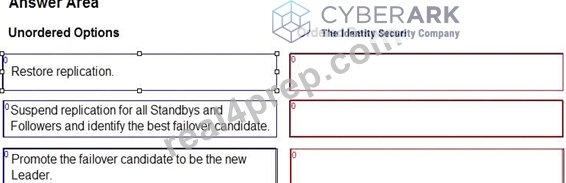
Answer:
Explanation:
Explanation
In the event of a Leader failure, you can perform a manual failover to promote one of the Standbys to be the new Leader. The manual failover process consists of the following steps:
Suspend replication for all Standbys and Followers and identify the best failover candidate. This step ensures that no data is lost or corrupted during the failover process. The best failover candidate is the Standby with the most advanced replication timeline, which means it has the most up-to-date data from the Leader.
Promote the failover candidate to be the new Leader. This step changes the role of the failover candidate from a Standby to a Leader, and updates its configuration accordingly. The new Leader can now accept write requests from clients and replicate data to other nodes.
Restore replication. This step re-establishes the replication connections between the new Leader and the other nodes, and rebases the replication of the other Standbys and Followers to the new Leader. This ensures that all nodes have the same data and are in sync with the new Leader.
References: The manual failover configuration steps are explained in detail in the Configure Manual Failover section of the CyberArk Conjur Enterprise documentation. The image in the question is taken from the same source.
NEW QUESTION # 44
An application is having authentication issues when trying to securely retrieve credential's from the Vault using the CCP webservices RESTAPI. CyberArk Support advised that further debugging should be enabled on the CCP server to output a trace file to review detailed logs to help isolate the problem.
What best describes how to enable debug for CCP?
- A. In the PVWA, go to the Applications tab, select the Application in question, go to Options > Logging and choose Debug.
- B. From the command line, run appprvmgr.exe update_config logging=debug.
- C. Edit the basic_appprovider.conf, change the "AIMWebServiceTrace" value, and restart the provider.
- D. Edit web.config. change the "AIMWebServiceTrace" value, restart Windows Web Server (IIS)
Answer: D
Explanation:
Explanation
The best way to enable debug for CCP is to edit the web.config file in the AIMWebService folder and change the value of the AIMWebServiceTrace parameter to 4, which is the verbose level. This will generate detailed logs in the AIMWSTrace.log file in the logs folder. The logs folder may need to be created manually and given the appropriate permissions for the IIS_IUSRS group. After changing the web.config file, the Windows Web Server (IIS) service needs to be restarted to apply the changes. This method is recommended by CyberArk Support and documented in the CyberArk Knowledge Base1.
Editing the basic_appprovider.conf file and changing the AIMWebServiceTrace value is not a valid option, as this parameter does not exist in this file. The basic_appprovider.conf file is used to configure the basic provider settings, such as the AppProviderVaultParmsFile, the AppProviderPort, and the AppProviderCacheMode. The AIMWebServiceTrace parameter is only found in the web.config file of the AIMWebService.
In the PVWA, going to the Applications tab, selecting the Application in question, and going to Options > Logging and choosing Debug is not a valid option, as this will only enable debug for the Application Identity Manager (AIM) component, not the CCP component. The AIM component is used to manage the application identities and their access to the Vault. The CCP component is used to provide secure retrieval of credentials from the Vault using web services. Enabling debug for AIM will generate logs in the APPconsole.log, APPtrace.log, and APPaudit.log files in the ApplicationPasswordProvider\Logs folder, but these logs will not help to troubleshoot the CCP authentication issues.
From the command line, running appprvmgr.exe update_config logging=debug is not a valid option, as this will only enable debug for the Application Provider Manager (APM) component, not the CCP component. The APM component is used to manage the configuration and operation of the providers, such as the basic provider, the LDAP provider, and the ENE provider. Running appprvmgr.exe update_config logging=debug will generate logs in the appprvmgr.log file in the ApplicationPasswordProvider\Logs folder, but these logs will not help to troubleshoot the CCP authentication issues. References:
Enable Debugging and Gather Logs - Central Credential Provider1
NEW QUESTION # 45
When working with Summon, what is the purpose of the secrets.yml file?
- A. It is where Summon outputs the secret value after retrieval.
- B. It is where you define which secrets to retrieve.
- C. It is where you store the Conjur URL and host API key.
- D. It is the log file for Summon.
Answer: B
Explanation:
Explanation
= Summon is a command-line tool that provides on-demand secrets access for common DevOps tools. It reads a file in secrets.yml format and injects secrets as environment variables into any process. The secrets.yml file is where you define which secrets to retrieve from a trusted store, such as CyberArk Secrets Manager. The secrets.yml file specifies the name and location of each secret, as well as the environment variable to assign it to. For example, a secrets.yml file could look like this:
DB_USERNAME: !var dev/my-app/db-username DB_PASSWORD: !var dev/my-app/db-password This means that Summon will fetch the values of dev/my-app/db-username and dev/my-app/db-password from the trusted store, and assign them to the environment variables DB_USERNAME and DB_PASSWORD, respectively. Then, Summon will run the specified process with these environment variables set, and remove them once the process exits. This way, Summon enables secure and convenient access to secrets without exposing them in plain text or storing them in files.
References = Summon by cyberark - GitHub Pages; Using Summon to Manage Secrets as You Move From Dev to Prod
NEW QUESTION # 46
When installing the CCP and configuring it for use behind a load balancer, which authentication methods may be affected? (Choose two.)
- A. OS User
- B. Allowed Machines authentication
- C. [Client Certificate authentication
- D. Path
- E. Hash
Answer: B,C
Explanation:
Explanation
The CCP (Central Credential Provider) is a tool that enables applications to securely retrieve credentials from CyberArk Secrets Manager without hard-coding or storing them in files. The CCP can be installed on a single server or on multiple servers behind a load balancer for high availability and scalability. The load balancer is a device or service that distributes the network traffic among the CCP servers based on predefined rules and criteria.
The CCP supports multiple methods to authenticate applications, such as Allowed Machines, Client Certificate, OS User, Path, and Hash. These methods are based on registering information in the Vault with the unique application ID. For more information about the supported authentication methods, see Application authentication methods1.
When installing the CCP and configuring it for use behind a load balancer, some authentication methods may be affected by the load balancer's behavior and settings. Specifically, the following authentication methods may be affected:
Allowed Machines authentication: This method authenticates applications based on their IP address or hostname. If the load balancer replaces the source IP or hostname of the routed packets with its own IP or hostname, the CCP will not be able to authenticate the application that initiated the credential request.
To enable the CCP to resolve the IP or hostname of the application, the load balancer needs to be configured as a transparent proxy or to attach the X-Forwarded-For header to the routed packets. For more information, see Load balance the Central Credential Provider2.
Client Certificate authentication: This method authenticates applications based on their client certificate that is signed by a trusted certificate authority (CA). The client certificate is used to establish a secure and trusted connection between the application and the CCP. If the load balancer terminates the SSL connection before proxying the traffic to the CCP, the CCP will not be able to verify the client certificate of the application. To enable the CCP to validate the client certificate, the load balancer needs to be configured as a pass-through proxy or to forward the client certificate to the CCP. For more information, see Load balance the Central Credential Provider2.
The other authentication methods are not affected by the load balancer, as they do not rely on the IP, hostname, or certificate of the application. For example, the OS User method authenticates applications based on their Windows domain user, the Path method authenticates applications based on their URL path, and the Hash method authenticates applications based on a hash value that is generated from the application ID and a shared secret. These methods do not require any special configuration on the load balancer or the CCP.
NEW QUESTION # 47
You modified a Conjur host policy to change its annotations for authentication.
How should you load the policy to make those changes?
- A. Use the "update" method (e.g. conjur policy load - -update <branch> <policy-file>).
- B. Use the "delete" method (e.g. conjur policy load - -delete <branch> <policy-file>).
- C. Use the "replace" method (e.g. conjur policy load - -replace <branch> <policy-file>).
- D. Use the default "append" method (e.g. conjur policy load <branch> <policy-file>).
Answer: C
Explanation:
Explanation
= According to the CyberArk Sentry Secrets Manager documentation, the replace method is used to overwrite an existing policy branch with a new policy file. This method is suitable for making changes to the existing resources, such as modifying their annotations, permissions, or attributes. The replace method preserves the existing data and secrets associated with the resources, but removes any resources that are not defined in the new policy file. Therefore, to change the annotations for authentication of a Conjur host, the replace method is the best option.
The append method is used to add new resources or data to an existing policy branch, without affecting the existing resources. This method is suitable for creating new hosts, groups, variables, or secrets, but not for modifying the existing ones. The append method will ignore any changes to the existing resources, such as annotations, and will only load the new resources or data.
The delete method is used to remove resources or data from an existing policy branch, without affecting the other resources. This method is suitable for deleting hosts, groups, variables, or secrets, but not for modifying them. The delete method will remove any resources or data that are defined in the policy file, and will ignore any resources or data that are not defined in the policy file.
The update method is used to modify the data or secrets associated with existing resources, without affecting the resources themselves. This method is suitable for changing the values of variables or secrets, but not for changing the annotations, permissions, or attributes of the resources. The update method will only load the data or secrets that are defined in the policy file, and will ignore any resources or data that are not defined in the policy file. References: = Annotation reference | CyberArk Docs; Policy load modes | CyberArk Docs; Policy - docs.cyberark.com
NEW QUESTION # 48
Refer to the exhibit.
How can you confirm that the Follower has a current copy of the database?
- A. Compare the pgcurrentxlog_locationlocation from the Leader to the Follower you need to validate against.
- B. Retrieve the credential from a test application on the Leader cluster; then retrieve against the Follower and compare if they are accurate.
- C. Validate that the Follower container ID matches the node in the info endpoint on the Leader.
- D. Count the number of components in pgstartreplication and compare this to the total number of Followers in the deployment.
Answer: A
Explanation:
Explanation
The exhibit shows a JSON object that contains the replication status of a database in a Secrets Manager cluster. Secrets Manager is a secrets management solution that securely stores and manages secrets and credentials used by applications, DevOps tools, and other systems. Secrets Manager can be deployed in a cluster mode, which consists of a Leader node and one or more Follower nodes. The Leader node is the primary node that handles all write operations and coordinates the replication of data to the Follower nodes.
The Follower nodes are read-only nodes that replicate data from the Leader node and serve requests from clients and applications that need to retrieve secrets or perform other read-only operations.
To confirm that the Follower has a current copy of the database, you can compare the pgcurrentxlog_locationlocation from the Leader to the Follower you need to validate against. The pgcurrentxlog_locationlocation is a property that indicates the current position of the write-ahead log (WAL) in the database. The WAL is a mechanism that records all changes made to the database in a sequential log file, before they are applied to the actual data files. The WAL ensures the durability and consistency of the database in case of a crash or a power failure. The WAL also enables the replication of data from the Leader node to the Follower nodes, by streaming the WAL records to the Follower nodes and applying them to their local databases.
By comparing the pgcurrentxlog_locationlocation from the Leader to the Follower, you can determine how far behind the Follower is from the Leader in terms of the WAL records. If the pgcurrentxlog_locationlocation values are identical or very close, it means that the Follower has a current copy of the database, and that the replication is working properly. If the pgcurrentxlog_locationlocation values are different or far apart, it means that the Follower has an outdated copy of the database, and that there is a replication lag or a replication failure. In that case, you may need to troubleshoot the replication issue and resolve it as soon as possible.
References = Secrets Manager Cluster Installation; Secrets Manager Cluster Configuration; Write-Ahead Logging - PostgreSQL Documentation
NEW QUESTION # 49
You are deploying Kubernetes resources/objects as Conjur identities.
In addition to Namespace and Deployment, from which options can you choose? (Choose two.)
- A. Tokenreviews
- B. ServiceAccount
- C. StatefulSet
- D. Replica sets
- E. Secrets
Answer: B,C
Explanation:
Explanation
ServiceAccount and StatefulSet are two of the Kubernetes resources/objects that can be used as Conjur identities, in addition to Namespace and Deployment. Conjur identities are the entities that can authenticate with Conjur and retrieve secrets from it. Conjur supports authenticating Kubernetes resources/objects using the Conjur Kubernetes Authenticator, which is a sidecar or init container that runs alongside the application container and injects the Conjur access token into a shared volume. The application container can then use the access token to fetch secrets from Conjur.
A ServiceAccount is a Kubernetes resource that represents an identity for processes that run in a pod.
ServiceAccounts can be used to grant specific privileges and permissions to the pod, and to enable communication with the Kubernetes API server. A ServiceAccount can be used as a Conjur identity by annotating it with the Conjur authentication policy branch ID, and by creating a Conjur host entity that matches the ServiceAccount name and namespace. The Conjur Kubernetes Authenticator will then use the ServiceAccount token to authenticate the pod with Conjur and obtain the Conjur access token.
A StatefulSet is a Kubernetes resource that manages the deployment and scaling of a set of pods, and provides guarantees about the ordering and uniqueness of these pods. StatefulSets are useful for applications that require stable and persistent identities, such as databases, message brokers, or distributed systems. A StatefulSet can be used as a Conjur identity by annotating it with the Conjur authentication policy branch ID, and by creating a Conjur host entity that matches the StatefulSet name and namespace. The Conjur Kubernetes Authenticator will then use the pod name and namespace to authenticate the pod with Conjur and obtain the Conjur access token.
The other options are not valid Kubernetes resources/objects that can be used as Conjur identities. Replica sets are a lower-level resource that are usually managed by higher-level resources such as Deployments or StatefulSets, and do not have their own identity or annotations. Secrets are a Kubernetes resource that store sensitive information such as passwords, tokens, or keys, and are not meant to be used as identities.
Tokenreviews are a Kubernetes resource that are used to verify the validity of a ServiceAccount token, and are not meant to be used as identities either. References:
Securing Secrets in Kubernetes - CyberArk Developer, Section "Conjur Kubernetes Authentication: A Hands-On Demonstration" GitHub - cyberark/secrets-provider-for-k8s: Cyberark secrets provider ..., Section "Consuming Secrets from CyberArk Secrets Provider" Secure your Kubernetes-deployed applications with CyberArk Conjur, Section "How it works" Simplify and Improve Container Security Using New CyberArk Conjur ..., Section "CyberArk Conjur Enterprise" Keeping Secrets Secure on Kubernetes - CyberArk Developer, Section "The Solution"
NEW QUESTION # 50
In the event of a failover of the Vault server from the primary to the DR, which configuration option ensures that a CP will continue being able to refresh its cache?
- A. Add the DR Vault IP address to the "Address" parameter in the file main_appprovider.conf.
<platform>.<version> found in the AppProviderConf safe. - B. Add the IP address of the DR vault to the "Address" parameter in the file Vault.ini.file on the machine on which the CP is installed.
- C. In the Password Vault Web Access UI, add the IP address of the DR Vault in the Disaster Recovery section under Applications > Options.
- D. In the Conjur UI, add the IP address of the DR Vault in the Disaster Recovery section under Cluster Config > Credential Provider > Options.
Answer: B
Explanation:
Explanation
This is the correct answer because the Vault.ini file on the CP machine contains the configuration settings for the CP to connect to the Vault server. The Address parameter specifies the IP address or hostname of the Vault server that the CP will use to communicate with the Vault. In the event of a failover of the Vault server from the primary to the DR, the CP needs to update the Address parameter with the IP address of the DR Vault server in order to continue being able to refresh its cache. The cache is a local storage of credentials that the CP retrieves from the Vault and provides to the applications. The cache is refreshed periodically based on the RefreshInterval parameter in the Vault.ini file. This answer is based on the CyberArk Secrets Manager documentation1 and the CyberArk Secrets Manager training course2.
The other options are not correct because they do not ensure that the CP will continue being able to refresh its cache in the event of a failover of the Vault server from the primary to the DR. Adding the DR Vault IP address to the Address parameter in the main_appprovider.conf.<platform>.<version> file in the AppProviderConf safe is not a valid option, as this file does not contain the Address parameter. The main_appprovider.conf file contains the configuration settings for the basic provider, such as the AppProviderVaultParmsFile, the AppProviderPort, and the AppProviderCacheMode. The Address parameter is only found in the Vault.ini file on the CP machine.
In the Password Vault Web Access (PVWA) UI, adding the IP address of the DR Vault in the Disaster Recovery section under Applications > Options is not a valid option, as this section does not exist in the PVWA UI. The PVWA UI does not have a Disaster Recovery section under Applications > Options. The PVWA UI has a Disaster Recovery section under Administration > Options, but this section is used to configure the DR Vault settings, such as the DR Vault IP address, the DR Vault user, and the DR Vault password. These settings are not related to the CP configuration or cache refresh.
In the Conjur UI, adding the IP address of the DR Vault in the Disaster Recovery section under Cluster Config
> Credential Provider > Options is not a valid option, as this section does not exist in the Conjur UI. The Conjur UI does not have a Cluster Config, Credential Provider, or Options section. The Conjur UI has a Cluster Config section under Settings, but this section is used to configure the Conjur cluster settings, such as the master IP address, the follower IP address, and the seed fetcher IP address. These settings are not related to the CP configuration or cache refresh.
NEW QUESTION # 51
Match each scenario to the appropriate Secrets Manager solution.
Answer:
Explanation:
Explanation
The appropriate Secrets Manager solution for each scenario is as follows:
token based retrieval of secrets, such as OIDC or JWT: Conjur
workloads requiring the fastest secrets delivery performance possible: ASCP agentless workload authentication that relies on OS User: CCP These solutions are described in the Secrets Management Tools page of the CyberArk website
NEW QUESTION # 52
A Kubernetes application attempting to authenticate to the Follower load balancer receives this error:
ERROR: 2024/10/30 06:07:08 authenticator.go:139: CAKC029E Received invalid response to certificate signing request. Reason: status code 401 When checking the logs, you see this message:
authn-k8s/prd-cluster-01 is not enabled
How do you remediate the issue?
- A. Enable the authenticator in the Ul > Webservices > Authenticators > Enable and enable the appropriate authenticator webservice.
- B. A network issue is preventing the application from reaching the Follower; correct the issue and verity that it is resolved.
- C. Check the info endpoint on each Follower behind the load balancer and enable the authenticator on the Follower.
- D. Modify conjur.conf in /opt/conjur/etc/authenticators addinqthe authenticator webservice.
Answer: D
Explanation:
Explanation
The error message indicates that the authenticator webservice is not enabled on the Conjur server. To enable the authenticator, you need to modify the conjur.conf file in the /opt/conjur/etc directory and add the authenticator webservice ID to the CONJUR_AUTHENTICATORS environment variable. For example, if the authenticator webservice ID is authn-k8s/prd-cluster-01, you need to add it to the existing value of CONJUR_AUTHENTICATORS, separated by a comma. Then, you need to restart the Conjur service for the changes to take effect. This will enable the authenticator on the Conjur server and allow the Kubernetes application to authenticate to the Follower load balancer. References: Enable the Authenticator Webservice, Configure the Authenticator Webservice
NEW QUESTION # 53
......
CyberArk Secret-Sen Study Guide Archives : https://prep4sure.real4prep.com/Secret-Sen-exam.html