


Get instant access to BAPv5 Practice Tests 2023 Free Updated Today!
Welcome to download the newest PassLeader BAPv5 PDF dumps ( 72 Q&As)
NEW QUESTION # 30
A business case features a management summary, from which the below extract is taken:
'The new approach will incur significant investment in terms of software licenses and annual maintenance fees, which will not be negotiable until year four of the proposal. We will research competing suppliers in the marketplace at end of year three, the supplier will, therefore, be likely to otter a reduced price for year five and beyond. However, we are convinced that the selected option is the right one. It will give us a competitive edge as a result of improved management information, in addition to the boost it will give to our image with our established customers." Which categories of costs and benefits are described in this extract*?
- A. Tangible benefits, intangible costs
- B. Intangible benefits, intangible costs
- C. Tangible costs, intangible benefits.
- D. Intangible costs, tangible benefits
Answer: D
Explanation:
Explanation
A business case is a formal written proposal that details the costs and benefits of a proposed business change or solution. It helps to justify and secure the approval and funding for a proposed business change or solution.
Costs and benefits can be classified into two types: tangible and intangible. Therefore, option D is the correct answer, as it identifies which categories of costs and benefits are described in this extract respectively.
Intangible costs are costs that have no physical existence and cannot be measured or quantified easily by human senses. Examples of intangible costs are reputation, image, morale etc. An example of intangible costs in this extract is significant investment in terms of software licenses and annual maintenance fees, which will not be negotiable until year four of the proposal, as it has no physical existence and cannot be measured or quantified easily by human senses. Tangible benefits are benefits that have physical existence and can be measured or quantified easily by human senses. Examples of tangible benefits are revenue, profit, market share etc. An example of tangible benefits in this extract is improved management information, in addition to the boost it will give to our image with our established customers, as it has physical existence and can be measured or quantified easily by human senses. Option A is not a correct answer, as it does not identify which categories of costs and benefits are described in this extract respectively. Tangible costs are costs that have physical existence and can be measured or quantified easily by human senses. Examples of tangible costs are equipment, materials, labour etc. There is no example of tangible costs in this extract. Intangible benefits are benefits that have no physical existence and cannot be measured or quantified easily by human senses.
Examples of intangible benefits are satisfaction, loyalty, quality etc. There is no example of intangible benefits in this extract (although image could be considered as an intangible benefit). Option B is not a correct answer, as it does not identify which categories of costs and benefits are described in this extract respectively. Tangible benefits are benefits that have physical existence and can be measured or quantified easily by human senses.
Examples of tangible benefits are revenue, profit, market share etc. An example of tangible benefits in this extract is improved management information, in addition to the boost it will give to our image with our established customers, as it has physical existence and can be measured or quantified easily by human senses.
Intangible costs are costs that have no physical existence and cannot be measured or quantified easily by human senses. Examples of intangible costs are reputation, image, morale etc. An example of intangible costs in this extract is significant investment in terms of software licenses and annual maintenance fees, which will not be negotiable until year four of the proposal, as it has no physical existence and cannot be measured or quantified easily by human senses. Option C is not a correct answer, as it does not identify any category of cost or benefit that has been described in this extract.
References: BCS Practitioner Certificate in BAP Specimen,
NEW QUESTION # 31
As pari of a strategic review for a recording company, Exquisite Analogue, Jay has been asked to undertake a resource audit As a result of him meeting with key stakeholders he has compiled a list of statements Which THREE of the following SHOULD be included in the resource audit?
- A. Imminent tax changes may impact profitability
- B. An offer has been made to purchase the company by a larger competitor
- C. In the back catalogue there are 20,000 analogue recordings
- D. Recent awards include Vinyl magazines 'Customers Choice Award'.
- E. There are two recording studios, one in London and one in Pans
Answer: C,D,E
Explanation:
Explanation
A resource audit is a technique for identifying and evaluating the resources that an organisation has or needs to achieve its objectives. It helps to assess the availability and quality of an organisation's resources, such as human, physical, financial and intangible resources. Therefore, options A, B and C are correct answers, as they should be included in the resource audit for Exquisite Analogue. They describe different types of resources that the organisation has and that contribute to its performance and potential. Option A describes a physical resource, which is a tangible asset that an organisation owns or uses, such as buildings, equipment or materials. Option B describes an intangible resource, which is a non-physical asset that an organisation owns or uses, such as intellectual property, brand or reputation. Option C describes a human resource, which is a person or group that an organisation employs or engages, such as staff, managers or customers. Option D is not a correct answer, as it should not be included in the resource audit for Exquisite Analogue. It describes a threat that affects the organisation externally, not a resource that the organisation has or needs internally.
Option E is not a correct answer, as it should not be included in the resource audit for Exquisite Analogue. It describes a factor that affects the organisation externally, not a resource that the organisation has or needs internally.
References: BCS Practitioner Certificate in BAP Specimen, page 32.
NEW QUESTION # 32
You have been discussing Paurs recent project with him He explained that he had needed to spend considerable time interviewing stakeholders and was now behind plan You asked him why he didn't use a workshop to avoid delays.
Which of the following MIGHT Paul reply'? Select the THREE that apply
- A. The stakeholders were located in different time zones
- B. Consensus from stakeholders needed to be established
- C. The challenge of organising key stakeholder diaries
- D. One stakeholder has a dominant personality
- E. A neutral venue was available for stakeholder discussions
Answer: A,C,E
Explanation:
Explanation
A workshop is a technique for conducting group discussions and activities with stakeholders to elicit, analyse, validate and prioritise their views and needs. It helps to facilitate effective communication and collaboration among stakeholders and resolve conflicts or issues. Therefore, options B, D and E are correct answers, as they are possible reasons why Paul did not use a workshop to avoid delays. They describe different challenges or constraints that may prevent or limit the use of a workshop technique. Option B describes a challenge related to the geographical location of stakeholders. If the stakeholders are located in different time zones, it may be difficult or impractical to arrange a workshop that suits their availability and preferences. Option D describes a challenge related to the availability of stakeholders. If the key stakeholders have busy or conflicting schedules, it may be hard or impossible to organise a workshop that involves all of them at the same time. Option E describes a constraint related to the venue of the workshop. If a neutral venue is available for stakeholder discussions, it may be preferable or necessary to use it instead of a workshop, as it may reduce bias or influence from any stakeholder group. Option A is not a correct answer, as it is not a reason why Paul did not use a workshop to avoid delays. It describes an issue that may arise during a workshop, but not prevent or limit its use. If one stakeholder has a dominant personality, it may affect the dynamics and outcomes of the workshop, but it can be managed by using appropriate facilitation skills and techniques. Option C is not a correct answer, as it is not a reason why Paul did not use a workshop to avoid delays. It describes an objective that may be achieved by using a workshop, but not prevent or limit its use. If consensus from stakeholders needs to be established, it may be beneficial or essential to use a workshop, as it can help to reach a common understanding and agreement among stakeholders.
References: BCS Practitioner Certificate in BAP Specimen, page 41.
NEW QUESTION # 33
An overseas bank is currently undertaking a feasibility study looking into the possible launch of a new bank in the UK Preliminary findings suggest that the market is saturated, customers have a lot of choice and it is easy for them to switch from one bank to another.
In which area of Porter's Five Forces model would these preliminary findings be documented'?
- A. Threat of new entrants
- B. Bargaining power of customers
- C. Threat of substitute products
- D. Bargaining power of suppliers
Answer: B
Explanation:
Explanation
Porter's Five Forces model is a technique for analysing the competitive forces that affect an organisation or industry. It helps to assess the attractiveness and profitability of an organisation or industry. Porter's Five Forces model consists of five forces: threat of new entrants, bargaining power of customers, bargaining power of suppliers, threat of substitute products and competitive rivalry. Therefore, option B is the correct answer, as these preliminary findings would be documented in the bargaining power of customers force of Porter's Five Forces model. Bargaining power of customers is the force that measures the ability and influence of customers to affect the price, quality and quantity of products or services offered by an organisation or industry. It depends on factors such as customer concentration, switching costs, differentiation and loyalty. An example of bargaining power of customers in this scenario is the market is saturated, customers have a lot of choice and it is easy for them to switch from one bank to another, which implies that customers have high bargaining power and can demand lower prices or better services from banks. Option A is not a correct answer, as these preliminary findings would not be documented in the threat of new entrants force of Porter's Five Forces model. Threat of new entrants is the force that measures the likelihood and impact of new competitors entering an organisation or industry. It depends on factors such as entry barriers, economies of scale, capital requirements and brand loyalty. An example of threat of new entrants in this scenario is an overseas bank launching a new bank in the UK, which implies that there is a potential threat of new entrants to the existing banks in the UK. Option C is not a correct answer, as these preliminary findings would not be documented in the bargaining power of suppliers force of Porter's Five Forces model. Bargaining power of suppliers is the force that measures the ability and influence of suppliers to affect the price, quality and quantity of products or services supplied to an organisation or industry. It depends on factors such as supplier concentration, switching costs, differentiation and dependency. An example of bargaining power of suppliers in this scenario is the suggested changes to the business structure will affect our relationships with suppliers, which implies that suppliers may have some bargaining power over the organisation or industry. Option D is not a correct answer, as these preliminary findings would not be documented in the threat of substitute products force of Porter's Five Forces model. Threat of substitute products is the force that measures the likelihood and impact of customers switching to alternative products or services that satisfy their needs or wants better than those offered by an organisation or industry. It depends on factors such as availability, price, quality and performance of substitute products or services. There is no example of threat of substitute products in this scenario.
References: BCS Practitioner Certificate in BAP Specimen, page 49.
NEW QUESTION # 34
The customer journey map below was created for Eyes 4'U. a chain of high street opticians This shows the journey of a person who is 67 years old and retired with a limited pension and active social life What are the MOST LIKELY statements to be in Box F and Box 6?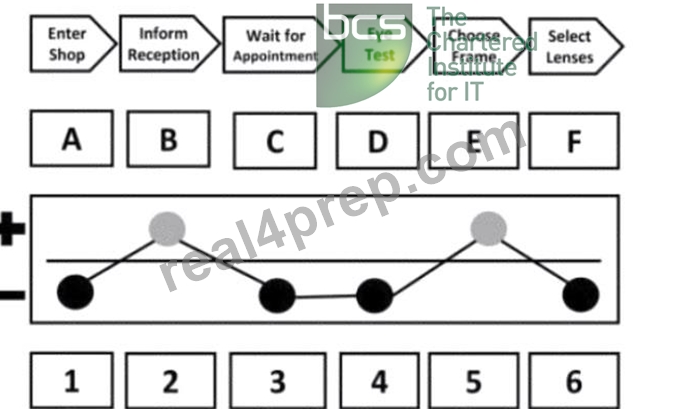
- A. F concern at cost 6 provide clearer information on options and pricing
- B. F provide clearer information on options and pricing 6 concern at cost
- C. F: worry about choosing the wrong frame 6: introduce virtual frame selection technology
- D. F pleased appointment ending 6 provide clearer information on options and pricing
Answer: A
Explanation:
Explanation
A customer journey map is a visual representation of the steps and emotions that a customer goes through when interacting with a product or service. It helps to identify the pain points and opportunities for improvement in the customer experience. A customer journey map typically consists of the following elements: stages, actions, thoughts, feelings, touchpoints and opportunities. Therefore, option A is the correct answer, as it matches the elements of the customer journey map for Box F and Box 6. Box F represents the feeling of the customer at the stage of choosing a frame. The feeling is concern at cost, as the customer is worried about the price of the frames and lenses. Box 6 represents the opportunity for improvement at the stage of selecting lenses. The opportunity is to provide clearer information on options and pricing, as this would help the customer to make an informed decision and reduce their anxiety. Option B is not a correct answer, as it does not match the elements of the customer journey map for Box F and Box 6. Box F represents the feeling of the customer, not an opportunity for improvement. Box 6 represents an opportunity for improvement, not a feeling of the customer. Option C is not a correct answer, as it does not match the elements of the customer journey map for Box F and Box 6. Box F represents the feeling of the customer, not an opportunity for improvement. Box 6 represents an opportunity for improvement, not a feeling of the customer.
Option D is not a correct answer, as it does not match the elements of the customer journey map for Box F and Box 6. Box F represents the feeling of the customer, not an opportunity for improvement. Box 6 represents an opportunity for improvement, not a feeling of the customer.
References: BCS Practitioner Certificate in BAP Specimen, page 23.
NEW QUESTION # 35
Ajay works I the payroll department of his organization. Payslips for every employee are printed automatically at the each month. He is about to distribute the monthly for each employee when he receives a notification from senior management explaining that the wish to give everyone a 10% bonus, for exceptional performance in the least quarter. Ajay is pleased with the bonus, but annoyed that the needs to re-print the monthly payslips.
Which types of business events can be identified from this scenario?
- A. Time based only
- B. External and Time based.
- C. External and Internal
- D. Internal and Time based.
Answer: A
Explanation:
Explanation
A time based event is one that occurs at a regular or predetermined interval, such as monthly or quarterly. In this scenario, the printing of the monthly payslips is a time based event, as it happens every month. The notification from senior management is not an external or internal event, as it is not triggered by an external or internal stakeholder or situation. Therefore, option D is the correct answer.
References:
Dependency arrows - IBM
oop - Explanation of the UML arrows - Stack Overflow
NEW QUESTION # 36
A division of a telecommunication company is reviewing its current product range. It has decided to reposition itself by narrowing its product scope to 'deliver consultancy service'. The activity is the primary doing activity doing on a business Activity Model (BAM) defined by the Chief Executive Officer (CEO). A number of other activities have been identified, five of which are listed below:
Determine which customer to target for
a) Determine which customers to target for our focused service.
b) Track the progress of consultancy contracts placed by customers.
c) Define the skills sets of the consultants supplying our service.
d) Agree on a marketing campaign to make people aware of our new product focus e) Run monthly open days, showcasing our consultancy expertise.
Which of these would be categorized as planning activities on the CEO's BAM?
- A. a, b and e.
- B. b, c and e.
- C. a. c and d
- D. c. d and e
Answer: D
Explanation:
Explanation
Planning activities are those that must be considered beforehand in order to complete the doing and enabling activities. They are usually related to defining or determining some aspects of the business. In this question, the activities c, d and e are planning activities, as they involve defining the skills sets of the consultants, agreeing on a marketing campaign, and running monthly open days. These activities are necessary to support the primary doing activity of delivering consultancy service. Option D is the correct answer.
NEW QUESTION # 37
The following planning activity has been identified in a consensus BAM for a company that makes clothes:
'P4 - Define marketing strategy'
Which of the following is an enabling activity linked to this planning activity?
- A. Define sales targets
- B. Monitor sales.
- C. Sell clothes
- D. Advertise clothes
Answer: A
Explanation:
Explanation
An enabling activity is an activity that supports or facilitates another activity within a business activity model.
It helps to ensure that another activity can be performed or delivered effectively and efficiently. Therefore, option B is the correct answer, as it is an enabling activity linked to this planning activity. Define sales targets is an enabling activity linked to this planning activity, as it supports or facilitates defining marketing strategy.
It helps to ensure that marketing strategy can be aligned with sales objectives and outcomes. Option A is not a correct answer, as it is not an enabling activity linked to this planning activity, but a monitoring and control activity. Monitor sales is a monitoring and control activity that measures or evaluates another activity within a business activity model. It helps to ensure that another activity meets quality and performance standards and criteria. Option C is not a correct answer, as it is not an enabling activity linked to this planning activity, but a doing activity. Advertise clothes is a doing activity that produces or delivers value or satisfaction for customers within a business activity model. It helps to achieve customer demand and satisfaction for products or services. Option D is not a correct answer, as it is not an enabling activity linked to this planning activity, but a doing activity. Sell clothes is a doing activity that produces or delivers value or satisfaction for customers within a business activity model. It helps to achieve customer demand and satisfaction for products or services.
References: BCS Practitioner Certificate in BAP Specimen, page 40.
NEW QUESTION # 38
A group of stakeholders at FlyMe travel operators are in a meeting to discus the Business Activity Model (BAM) for a new subsidiary business. They are planning to launch a new offering, which will offer flight bundle' packages for organization that regularly need to send their staff overseas. The following activities have been identified so far:
a) Monitor flight bundle' sates
b) Sell "night bundles*
c) Determine demand amongst existing customers
d) Identify potential airline earners
e) Determine 'flight bundle' locations,
f) Define bundle pricing.
Although the Operations Director for FlyMe is supportive of the new business proposition, she is not entirely convinced there is a gap in the market, nor is she confident that the idea will be profitable.
With these concerns in mind, which planning activities will she be keen to ensure are discussed before the meeting ends?
- A. b, d and e
- B. a, b. d and e.
- C. c and f
- D. a. c and f
Answer: C
Explanation:
Explanation
The Operations Director for FlyMe is concerned about the market demand and profitability of the new business proposition. Therefore, she will be keen to ensure that the planning activities that address these concerns are discussed before the meeting ends. These activities are c and f, as they involve determining the demand amongst existing customers and defining the bundle pricing. These activities will help to assess the feasibility and viability of the new offering. Option A is the correct answer.
NEW QUESTION # 39
A local council wishes to improve its housing allocation process. The following notes were made by the head of housing about the current process.
Housing application decision are made using a set of criteria based on a range of factors, including the length of time application has been on the waiting list and the number of dependents they have. The criteria by the council housing committee, who meet on a regular basis and seek to ensure that the criteria continue to enable effective housing allocation.
Occasionally, legislation ensuring protection for the most vulnerable people in our society can affect the criteria, as can changes issued by central government concerning practical issues, such as building regulations?
Which of the following types(s) of business rule has been described in this extract?
- A. External constrains and internal policies.
- B. External constraints and external procedures.
- C. Internal procedures.
- D. Internal policies and internal procedures.
Answer: A
Explanation:
Explanation
A business rule is a statement that defines or constrains some aspect of a business situation or problem or its solution. It helps to ensure consistency and compliance with policies, regulations, standards or criteria within an organisation or project. Business rules can be classified into four types: external constraints, internal policies, external procedures and internal procedures. Therefore, option B is the correct answer, as it identifies which types(s) of business rule have been described in this extract respectively. External constraints are business rules that originate from outside an organisation or project and are beyond its control or influence.
They help to ensure compliance with laws, regulations, standards or criteria imposed by external authorities or bodies. An example of external constraints in this extract is legislation ensuring protection for the most vulnerable people in our society can affect the criteria, as it originates from outside the local council and is beyond its control or influence. Internal policies are business rules that originate from within an organisation or project and are under its control or influence. They help to ensure alignment with objectives, strategies, values or principles established by internal decision makers or influencers. An example of internal policies in this extract is the criteria are agreed by the council housing committee, who meet on a regular basis and seek to ensure that the criteria continue to enable effective housing allocation, as it originates from within the local council and is under its control or influence. Option A is not a correct answer, as it does not identify which types(s) of business rule have been described in this extract respectively. Internal policies and internal procedures are not the types of business rule that have been described in this extract. Internal procedures are business rules that specify how an activity or task should be performed or delivered within an organisation or project. They help to ensure quality and consistency of performance or delivery within an organisation or project. There is no example of internal procedures in this extract. Option C is not a correct answer, as it does not identify which types(s) of business rule have been described in this extract respectively. External constraints and external procedures are not the types of business rule that have been described in this extract.
External procedures are business rules that specify how an activity or task should be performed or delivered outside an organisation or project. They help to ensure compatibility and interoperability of performance or delivery with external parties or systems. There is no example of external procedures in this extract. Option D is not a correct answer, as it does not identify any type of business rule that has been described in this extract.
References: BCS Practitioner Certificate in BAP Specimen, page 41.
NEW QUESTION # 40
Halliday Holdings is embarking on a programme to improve its customer experience On joining the programme. Natasha wants to gain an understanding of how its current brand is perceived Which would be the BEST source of information for Natasha?
- A. The company's complaints procedures
- B. The company website
- C. Independent industry websites
- D. The company's organisational structure
Answer: C
Explanation:
Explanation
A brand is a name, term, design, symbol or any other feature that identifies one seller's good or service as distinct from those of other sellers. A brand perception is how customers and potential customers view a brand based on their experiences, associations and impressions. Therefore, option A is the best choice, as independent industry websites are likely to provide unbiased and reliable information on how customers perceive different brands in the market. They may also include customer reviews, ratings and feedback that can help measure customer satisfaction and loyalty. Option B is not a good choice, as the company website is likely to provide biased and selective information on its own brand that may not reflect how customers actually perceive it. It may also omit negative aspects or criticisms that could affect its image or reputation.
Option C is not a good choice, as the company's organisational structure is not relevant to its brand perception.
It may show how the company is organised internally, but it does not indicate how customers view its products or services externally. Option D is not a good choice, as the company's complaints procedures are not sufficient to measure its brand perception. They may show how the company handles customer issues or problems, but they do not capture how customers feel about its overall quality or value.
References: BCS Practitioner Certificate in BAP Specimen, page 22.
NEW QUESTION # 41
The below statements have been made about the consensus Business Activity Model (BAM) Which THREE of the statements are TRUE?
- A. Shows the logical sequence of process steps
- B. A conceptual model
- C. Forms the basis of subsequent gap analysis
- D. Describes a stakeholder's perspective on what the business does
- E. Shows who undertakes the business activities
Answer: A,B,C
Explanation:
Explanation
A consensus Business Activity Model (BAM) is a diagram that shows the high level activities that an organisation performs or delivers and the flow or sequence of the activities. It helps to understand what an organisation does, how it does it, who does it, where it does it and why it does it from a common or shared perspective of all relevant stakeholder groups. Therefore, options A, C and D are true statements about a consensus BAM. Option A is a true statement, as a consensus BAM is a conceptual model that represents a business situation or problem at a high level of abstraction. It helps to simplify and clarify the complexity and ambiguity of the business situation or problem. Option C is a true statement, as a consensus BAM shows the logical sequence of process steps that the organisation follows or performs to achieve its objectives and outcomes. It helps to identify the order and dependencies of the activities and how they are connected or related. Option D is a true statement, as a consensus BAM forms the basis of subsequent gap analysis that compares the current and desired situations or problems and identifies the differences or gaps between them. It helps to determine what changes or improvements are needed to bridge the gaps and achieve the desired situation or problem. Option B is not a true statement, as a consensus BAM does not show who undertakes the business activities, but what the business activities are. The actors or performers of the business activities are shown in another technique, such as RACI chart. Option E is not a true statement, as a consensus BAM does not describe a stakeholder's perspective on what the business does, but a common or shared perspective of all stakeholder groups on what the business does. A stakeholder's perspective on what the business does is described in another technique, such as CATWOE.
References: BCS Practitioner Certificate in BAP Specimen, page 45.
NEW QUESTION # 42
A large mortgage provider has been running a project to develop an equity release product The project has run into difficulty due to a disagreement between two key stakeholders about whether the product should be developed in house or outsourced to a specialist company.
The business analyst on the project. George, has been discussing his role in resolving this problem with his manager.
Which of the following descriptions is George's manager LEAST LIKELY to use in describing his role'?
- A. To facilitate the discussion to allow the stakeholders to find a way forward
- B. To understand and challenge the stakeholders
- C. To record the meeting and the resulting decision
- D. To negotiate with the stakeholders to reach a resolution
Answer: D
Explanation:
Explanation
The role of a business analyst (BA) is to analyse business situations and problems, identify and evaluate potential solutions, and facilitate change within an organisation or project. A BA works with stakeholders at different levels and with different interests and perspectives to understand their needs and expectations and ensure they are met by suitable solutions. Therefore, option C is not likely to be used by George's manager in describing his role as a BA in resolving this problem. To negotiate with stakeholders to reach resolution implies that George has to persuade or compromise with stakeholders to agree on one solution or approach.
This is not part of the BA's role, as the BA does not have the authority or responsibility to make decisions or impose solutions on stakeholders. The BA's role is to analyse and evaluate different solutions or approaches objectively and present the findings and recommendations to stakeholders for their consideration and approval.
Option A is likely to be used by George's manager in describing his role as a BA in resolving this problem. To understand and challenge the stakeholders means that George has to elicit and validate the stakeholders' views and needs and question their assumptions and rationale. This is part of the BA's role, as the BA has to ensure that the stakeholders' views and needs are clear, consistent, realistic and aligned with the organisation's strategy and objectives. Option B is likely to be used by George's manager in describing his role as a BA in resolving this problem. To facilitate the discussion to allow the stakeholders to find a way forward means that George has to organise and conduct meetings or workshops with stakeholders to explore and evaluate different solutions or approaches and help them reach a consensus or agreement. This is part of the BA's role, as the BA has to enable effective communication and collaboration among stakeholders and help them resolve conflicts or issues. Option D is likely to be used by George's manager in describing his role as a BA in resolving this problem. To record the meeting and the resulting decision means that George has to document and communicate the outcomes and actions of the meeting or workshop with stakeholders and ensure they are understood and accepted by all parties. This is part of the BA's role, as the BA has to ensure that there is a clear and accurate record of what has been discussed and decided by stakeholders and that there is a shared understanding and commitment among them.
References: BCS Practitioner Certificate in BAP Specimen, page 36.
NEW QUESTION # 43
Paul has been struggling to make his farm profitable for a number of years Recently, an energy firm has asked him if it can survey his land in order to determine if there is natural gas deep under his fields If there is. they will pay him for the extracted gas.
Paul has discussed this request with his business partner, explaining that he would like to explore the possibility as he feels that any subsequent extraction process is safe, will cause minimal damage to the farm, and will return the farm to profitability. Paul's business partner disagrees, believing that the process for extracting the gas is dangerous, that the machinery will spoil the landscape and that it would undermine the vision they had of living off the land.
On which element of CATWOE are Paul and his business partner in disagreement?
- A. Transformation
- B. Work view
- C. Actor
- D. Customer
Answer: B
Explanation:
Explanation
CATWOE is a technique for exploring stakeholder business perspectives by identifying six elements:
Customer, Actor, Transformation, Worldview, Owner and Environment. It helps to understand how different stakeholders perceive a business situation or problem and what they expect from a solution. Therefore, option D is the correct answer, as Paul and his business partner are in disagreement on their worldview element of CATWOE. Worldview is the element that describes the beliefs, values, assumptions or principles that underpin a stakeholder's perspective. It helps to explain why a stakeholder thinks that a business situation or problem is worth addressing or solving. Paul and his business partner have different worldviews regarding the possibility of extracting natural gas from their land. Paul believes that it is a safe, profitable and reasonable option that will improve their financial situation. His business partner believes that it is a dangerous, unattractive and unacceptable option that will compromise their vision of living off the land. Option A is not a correct answer, as Paul and his business partner are not in disagreement on their customer element of CATWOE. Customer is the element that describes who benefits from or is affected by a business situation or problem or its solution. It helps to identify who are the main beneficiaries or victims of a business situation or problem or its solution. Paul and his business partner have the same customer, which is themselves as the owners of the farm. Option B is not a correct answer, as Paul and his business partner are not in disagreement on their actor element of CATWOE. Actor is the element that describes who carries out or performs a business situation or problem or its solution. It helps to identify who are responsible for implementing or delivering a business situation or problem or its solution. Paul and his business partner have the same actor, which is themselves as the owners of the farm. Option C is not a correct answer, as Paul and his business partner are not in disagreement on their transformation element of CATWOE. Transformation is the element that describes what changes or processes take place in a business situation or problem or its solution. It helps to identify what inputs are converted into outputs in a business situation or problem or its solution. Paul and his business partner have the same transformation, which is extracting natural gas from their land.
References: BCS Practitioner Certificate in BAP Specimen, page 37.
NEW QUESTION # 44
A report has been created into improving the scheduling of physio appointments at a major hospital An extract reads
'The scheduling team have a strong set of skills that will not need to be updated However, the team should be split into two. one dealing with inpatients and one with outpatients The introduction of a new telephony software and an online booking system will also require changes to the process' How might these changes be BEST presented to communicate with the scheduling team'?
- A. Business Process Model
- B. POPIT
- C. Prototype
- D. Business Activity Model
Answer: C
Explanation:
Explanation
A prototype is a simplified version of a proposed system or product that can be used to demonstrate its functionality and usability to the stakeholders. A prototype can be useful for communicating changes that involve new technology or software, as it allows the users to interact with the system and provide feedback.
Therefore, option D is the best choice, as it would allow the scheduling team to see how the new telephony software and online booking system would work and how they would affect their process. Option A is not a good choice, as a business process model is a graphical representation of the activities, inputs, outputs and resources involved in a business process. It would not show how the new software would work or how the team would be split. Option B is not a good choice, as a business activity model is a high-level view of the business activities that take place within an organisation. It would not show the details of the scheduling process or the new software. Option C is not a good choice, as POPIT is an acronym for People, Organisation, Process, Information and Technology. It is a framework for taking a holistic view of a business situation, but it is not a tool for communicating changes.
References: BCS Practitioner Certificate in BAP Specimen, page 16.
NEW QUESTION # 45
Bluesky Travel is an independent travel agency specialising in luxury bespoke holidays, which is introducing a new booking process. So far, the following key changes have been made:
1) The new Commercial Off The Shelf (COTS) software package for making bookings has been installed and is working
2) Data is being migrated from the old computer system to the COTS software package
3) The IT department has documented the configuration of the COTS system
4) The legal department has confirmed that the new COTS system is compliant with company policies.
In taking a holistic approach, which of the following areas of the POPII Model have NOT yet been addressed by the changes identified?
- A. Organisation and process.
- B. Organisation and information.
- C. People and technology
- D. Process and people
Answer: A
Explanation:
Explanation
The elements of the POPII model that have not yet been addressed by the changes identified are organisation and process. This is because there is no mention of how the new booking process will affect the organisational structure, roles, responsibilities, and culture of the company, or how the new COTS software package will integrate with the existing business processes and workflows. These elements are important to consider when introducing a new system or technology, as they may require changes or adaptations to ensure alignment and compatibility. Option A is the correct answer.
References:
POPIT Model Business Analysis Technique - Knowledge Train
POPIT Model - GSU
NEW QUESTION # 46
......
Nov-2023 Latest Prep4away BAPv5 Exam Dumps with PDF and Exam Engine: https://prep4sure.real4prep.com/BAPv5-exam.html